Electric charge:
It is an intrinsic characteristic of the fundamental particles making up those objects, i.e., it is a characteristic that automatically accompanies those particles whenever they exist. There are two types of charges: positive charge and Negative charge, as shown in Fig.

When both kinds of charges are equal in number in an object, the object is said to be electrically neutral or electrically balanced. Charges with the same electrical sign repel each other, and charges with opposite electrical signs attract each other.
Insulators: Materials in which charge can not move freely are called bad conductors or insulators eg, glass, plastic, chemically pure water etc.
Semiconductors: Materials that are intermediate between good conductors and insulators are called semiconductors,s such as, etc
Coulomb’s Law
Coulomb’s Law states that the electrostatic force of attraction or repulsion between two point charges is directly proportional to the product of the magnitudes of the charges and inversely proportional to the square of the distance between them. The force acts along the line joining the two charges. Mathematically Coulomb’s law can be expressed as
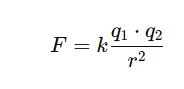
Where:
- = electrostatic force between the charges
- q1_ and q2q = magnitudes of the two charges
- = distance between the charges
- = Coulomb’s constant (8.99×10⁹ Nm2/C2
The Shell Theorem is a concept from electrostatics which explains the effect of a uniformly charged spherical shell on a charged particle. It has two important parts:
Outside the Shell:
A shell of uniform charge attracts or repels a charged particle located outside the shell as if all the shell’s charge is concentrated at the center of the shell.Inside the Shell:
If a charged particle is located inside a shell of uniform charge, then the net electrostatic force on the particle due to the shell is zero. This means the particle feels no force from the shell.
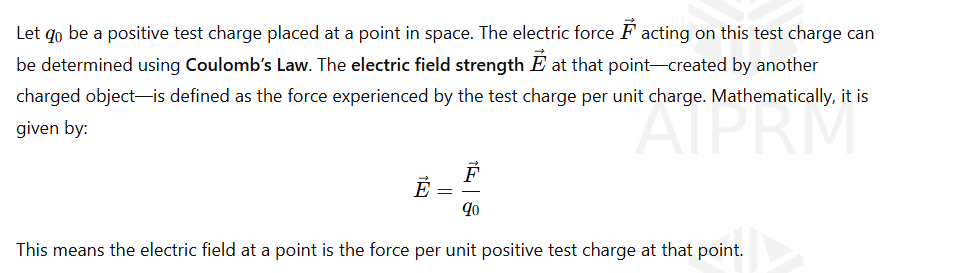
Electric Field Strength