Entity Relationship Model (ER-Model)
2.1 Introduction of ER-Model
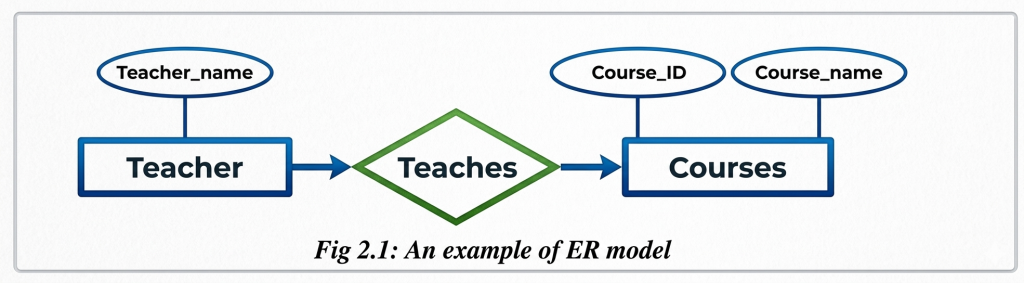
The Entity-Relational (ER) Model is a method used to design a database. It helps us identify the main objects (called entities) that need to be stored in a database and shows how these objects are connected to each other. The ER data model describes the overall structure of a database in a clear and graphical form. This structure is called the enterprise schema, which shows how all data is organized logically.
An Entity Relationship (ER) Diagram is used to explain the relationships between different entities in a database. It represents real-world objects such as a person, a car, or a company, and shows how they are related.In short, an ER diagram is a visual or structural representation of how a database is organized.
Use of ER Diagram or Applications of ER Diagram
- Database Design: ER diagrams help in planning and designing databases by clearly showing the relationships between different data entities.
- Documentation: They work as a reference or guide that gives an overview of the system structure. This helps new team members or users understand the database easily.
- Finding Problems Early: ER diagrams help identify and solve possible problems in the database design before development begins, which saves time later.
- Maintenance and Upgrading: During system updates or maintenance, ER diagrams help understand how changes will affect different parts of the database.
- Easy to Understand: ER diagrams are simple to create and easy to understand, even for beginners or new users.
- Data Analysis: They help in building an effective database structure, which makes data analysis easier and more useful.
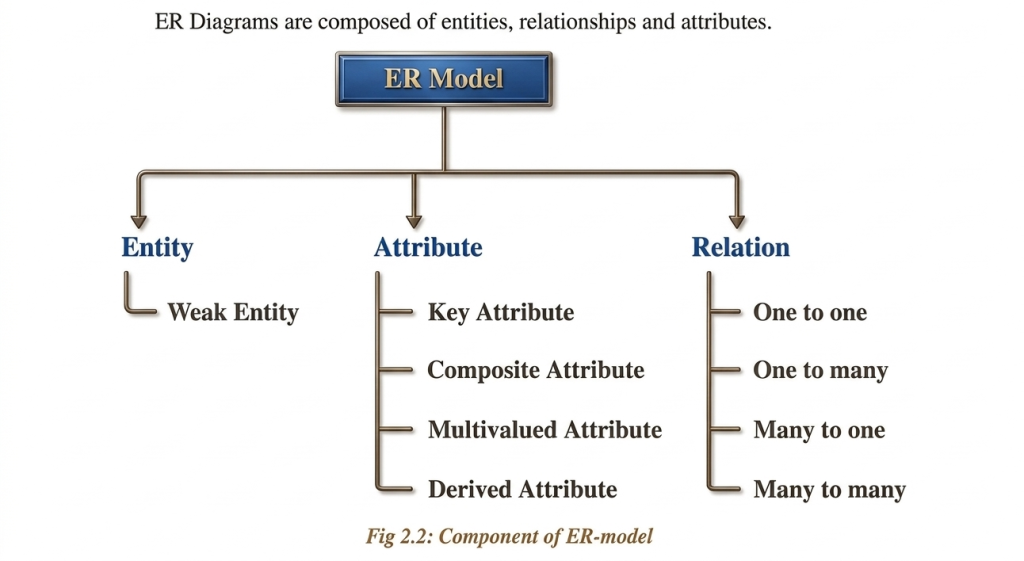
2.2 Component of ER model:
Entity
An entity is anything that we want to store information about in a database. It can be an object, a class, a person, or a place. In an ER diagram, an entity is shown as a rectangle.

Weak Entity
A weak entity is an entity that depends on another entity and does not have its own key attribute; it is shown by a double rectangle in an ER diagram.

An entity set is a collection of similar entities, such as students, motorbikes, smartphones, or customers. It is of two types:
1. Strong Entity Set
A strong entity set is a group of entities that has its own primary key, so each entity can be uniquely identified. For example, motorbikes can be identified by their registration number.
2. Weak Entity Set
A weak entity set is a group of entities that does not have a primary key of its own, so it cannot be uniquely identified by itself and depends on another entity. For example, smartphones identified only by name, colour, and RAM
Attributes, Types of Attributes
An attribute is used to describe the properties of an entity. It is represented by an ellipse (oval) in an ER diagram. For example, ID, age, contact number, and name are attributes of a student.

Types of Attributes
i. Key Attribute
A key attribute is used to represent the main characteristic of an entity and acts as a primary key. It is shown by an ellipse (oval) with the attribute name underlined in an ER diagram.
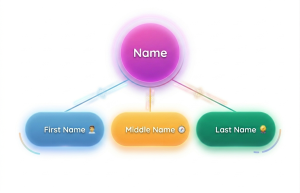
ii Composite Attribute
A composite attribute is an attribute that is made up of two or more smaller attributes. For example, a full name can be divided into first name, middle name, and last name.

Example 1: Creating Employee table with Composite ContactInfo Attribute.
CREATE TABLE Employee (
EmployeeID INT PRIMARY KEY,
Name VARCHAR(50),
-- Composite Attribute Contactnfo
ContactInfo VARCHAR(100)
);
INSERT INTO Employee (EmployeeID, Name, ContactInfo)
VALUES
(1, 'John Doe', 'john@example.com, 123-456-7890'),
(2, 'Jane Smith', 'jane@example.com, 456-789-0123'),
(3, 'Alice Johnson', 'alice@example.com, 789-012-3456');Employee Table
EMPLOYEEID | NAME | CONTACTINFO |
|---|---|---|
| 1 | John Doe | john@example.com, 123-456-7890 |
| 2 | Jane Smith | jane@example.com, 456-789-0123 |
| 3 | Alice Johnson | alice@example.com, 789-012-3456 |
Example 2: Creating Student Table where Address is composite attribute
Here we will create a Student table where student address is the composite key and it contains Street, City and Pin number in it.
CREATE TABLE Student (
StudentID INT PRIMARY KEY,
Name VARCHAR(50),
Address VARCHAR(100) -- Composite Attribute
);
INSERT INTO Student (StudentID, Name, Address)
VALUES
(1, 'John Doe', '123 Main Street, Apt 2, 10001'),
(2, 'Jane Smith', '456 Elm Street, Suite 3B, 20002'),
(3, 'Alice Johnson', '789 Oak Avenue, 30003');Student Table
STUDENTID | NAME | ADDRESS |
|---|---|---|
| 1 | John Doe | 123 Main Street, Apt 2, 10001 |
| 2 | Jane Smith | 456 Elm Street, Suite 3B, 20002 |
| 3 | Alice Johnson | 789 Oak Avenue, 30003 |
iii Multivalued Attribute
A multivalued attribute is an attribute that can have more than one value for a single entity. It is represented by a double oval in an ER diagram. Example: A student can have more than one phone number, so phone number is a multivalued attribute.

Example-1: Suppose there is an attribute in “student ” table called “ Interests ” which can contain multiple values of the student’s interests. This attribute would display the various interests that students would have like “sports”, “music”, “programming etc. Due to the multiple-values functionality of this attribute, the database will be able to contain a number of information regarding the student’s preferences and activities.
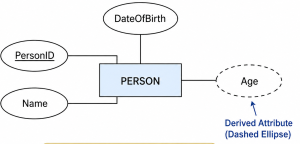
iv. Derived Attribute
An attribute that can be derived from another attribute is known as a derived attribute. It is represented by a dashed ellipse.
For example, a person’s age changes over time and can be derived from another attribute, such as the date of birth.
Features of Derived Attribute
- It is calculated from one or more other attributes.
- It is not usually stored in the database; it is computed when needed.
- It is represented by a dashed ellipse in an ER diagram.
- Its value can change automatically when the related attributes change.
- It helps reduce redundancy in data storage.
Advantages of Derived Attribute
- Saves storage space because it is not stored permanently.
- Ensures data consistency since values are calculated from original data.
- Reduces data redundancy.
- Automatically updates when base attributes change.
Disadvantages of Derived Attribute
- Requires extra computation time when the value is needed.
- Can slow down system performance if used frequently on large data.
- Cannot be accessed directly without calculation.
- May increase complexity in database design.
Relationship (Definition)
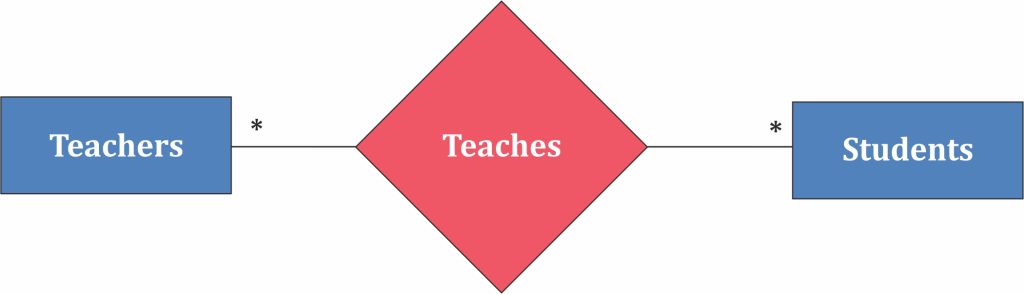
A relationship in DBMS is a link between two or more entities. It shows how data in one table is connected to data in another table. Relationships help in organizing and structuring the database properly. They are usually represented by a diamond shape in an ER diagram
Types Of Relationships In Database
1. One-to-One (1:1) Relationship
A one-to-one relationship means one entity is linked to only one other entity. Each record in one table corresponds to exactly one record in another table. Both entities have a direct and unique connection with each other. Example: One person has one passport.
2.One-to-Many (1:M) Relationship
A one-to-many relationship means one entity can be related to many other entities. However, each of those entities is connected to only one main entity. This is the most common type of relationship in database systems. Example: One teacher teaches many students.
3.Many-to-One (M:1) Relationship
A many-to-one relationship means many entities are associated with a single entity. Multiple records in one table are linked to one record in another table. It is the reverse form of a one-to-many relationship. Example: Many students belong to one class.
4. Many-to-Many (M:N) Relationship
A many-to-many relationship means many entities are related to many other entities. Records in one table can connect with multiple records in another table. This type of relationship is usually implemented using a junction table. Example: Students enroll in many courses.
Types of Mapping Cardinalities
One-to-One (1:1) Mapping
In one-to-one mapping, one entity is related to only one entity in another set. Each instance of both entities is uniquely connected. There is a direct and exclusive relationship between them. Example: One person has one passport.
One-to-Many (1:M) Mapping
In one-to-many mapping, one entity can be related to many entities in another set. However, each entity in the second set is linked to only one entity in the first set. This type is commonly used in databases. Example: One teacher teaches many students.
Many-to-One (M:1) Mapping
In many-to-one mapping, many entities are related to one entity. Multiple instances of one set are connected to a single instance of another set. It is the reverse of one-to-many mapping. Example: Many students belong to one class.
Many-to-Many (M:N) Mapping
In many-to-many mapping, many entities are related to many entities in another set. Each instance of one entity can be associated with multiple instances of another. This relationship is usually implemented using a junction table. Example: Students enroll in many courses.
Different Types of Database Keys
In a DBMS (Database Management System), the term “keys” refers to attributes (or sets of attributes) used to identify, access, and maintain relationships between records in a database table.
1. Primary Key
A primary key is a column or a group of columns used to uniquely identify each record in a table. Each table can have only one primary key. The values in a primary key must be unique and cannot be repeated. It also cannot contain null (empty) values.
2. Super Key
A super key is a set of one or more columns that can uniquely identify each row in a table. It may contain extra columns along with the required ones. Every primary key is a super key, but not every super key is a primary key. We choose the primary key from the set of superkeys.
3. Candidate Key
A candidate key is a column or a set of columns that can uniquely identify each row in a table. A table can have more than one candidate key. From these candidate keys, we select one to become the primary key. Candidate keys have the same properties as a primary key, such as uniqueness and no null values.
4. Alternate Key
An alternate key is any candidate key that is not selected as the primary key. Since a table can have multiple candidate keys but only one primary key, the remaining candidate keys are called alternate keys.
5. Foreign Key
A foreign key is a column or a set of columns used to create a relationship between two tables. It refers to the primary key of another table. The values in a foreign key must match the values in the referenced primary key. Foreign keys help maintain data consistency and referential integrity between tables.
6. Composite Key
A composite key is a combination of two or more columns used to uniquely identify each record in a table. Individually, these columns may not be unique, but together they ensure uniqueness of each row.
Importance of Database Keys
- Database keys help to uniquely identify each record in a table, so no two rows are the same.
- Keys ensure that the data in the database remains accurate and consistent by preventing duplicate and invalid entries.
- Foreign keys help to create relationships between different tables, making the database more organized and meaningful.
- Keys make it faster and easier to search, update, and delete records in a database.
- Keys reduce duplication of data by linking related tables instead of storing the same data repeatedly.
- Keys ensure that relationships between tables remain valid, meaning data in one table correctly matches data in another.
- Using keys properly helps in designing a well-structured and efficient database system.
What Is the Supreme Court of the United States?
The Supreme Court of the United States stands at the very top of the American judicial system. Think of it as the final referee in the nation’s legal game — when disagreements about laws, rights, or government authority reach their highest level, this Court makes the ultimate call. Created by the U.S. Constitution in 1789, it serves as the highest interpreter of federal law and constitutional meaning. Every decision it makes becomes binding across all states, influencing millions of lives far beyond the courtroom walls.
Unlike ordinary courts that focus on individual disputes, the Supreme Court often deals with questions that shape the direction of a country. Should a law remain valid? Did the government exceed its authority? Are individual rights protected under changing circumstances? These are not small questions; they define how democracy functions daily. Because of this immense responsibility, even a single ruling can transform policies, industries, or social norms overnight.
The Court hears only a limited number of cases each year — usually fewer than 100 — yet those decisions carry enormous weight. Many cases begin in lower courts and climb through appeals before reaching this final stage. When the justices agree to hear a case, it signals that the issue has national importance or conflicting interpretations among lower courts.
For citizens, the Supreme Court acts as both shield and compass. It protects constitutional rights while guiding how laws evolve over time. Whether people realize it or not, decisions about education, speech, healthcare, technology, elections, and personal freedoms often trace back to rulings issued inside this institution.
Constitutional Foundation
The authority of the Supreme Court comes directly from Article III of the U.S. Constitution, which established a federal judiciary but left Congress to determine its structure. Over time, legislation defined the Court’s size and procedures, eventually settling on nine justices — one Chief Justice and eight Associate Justices.
The Constitution intentionally gave the Court independence from political pressure. Justices receive lifetime appointments, meaning they do not need to campaign for reelection or respond to public opinion trends. The founders believed this structure would allow judges to protect minority rights even when decisions proved unpopular.
This constitutional design also created separation of powers. While Congress makes laws and the President enforces them, the Supreme Court ensures those actions comply with the Constitution. That balance prevents any single branch from becoming too powerful.
Why the Court Matters Today
In modern America, the Supreme Court influences issues ranging from digital privacy to immigration policy. Recent terms have addressed presidential authority, federal agency powers, voting laws, and free speech disputes. The Court’s rulings can reshape entire policy areas overnight, which explains why its decisions dominate headlines worldwide.
Public attention has increased dramatically in recent years as controversial cases have sparked debates about civil rights and government limits. Studies analyzing modern rulings show growing ideological divisions within decisions, reflecting broader political polarization in society.
Historical Evolution of the Supreme Court
The Supreme Court did not always hold the immense power it has today. In its early years, it was considered the weakest branch of government. Justices traveled long distances by horseback to hear cases, and the Court lacked a permanent building for decades. Its transformation into a dominant constitutional authority happened gradually through historic decisions and changing political realities.
Early Years and Judicial Authority
One of the most defining moments came in 1803 with Marbury v. Madison, where the Court established judicial review — the power to declare laws unconstitutional. Although the Constitution never explicitly states this authority, the ruling made the Court the ultimate interpreter of constitutional meaning. That single decision elevated the judiciary from a passive institution into a coequal branch of government.
Throughout the 19th century, the Court navigated issues involving federal versus state authority, economic regulation, and civil liberties. Decisions during this period shaped America’s legal framework, especially regarding commerce and property rights. The Court became increasingly central to resolving national conflicts, especially during periods of social transformation.
Landmark Turning Points
The 20th century marked the Court’s expansion into civil rights and social policy. Decisions addressing racial segregation, free speech, and criminal justice transformed American society. The Warren Court era, in particular, expanded individual rights protections, dramatically changing how the Constitution applied to everyday life.
In contrast, modern courts often focus on balancing regulatory power with constitutional limits. Recent decades have seen debates over executive authority, administrative agencies, and religious freedoms. Analysts note that contemporary rulings increasingly reflect ideological divisions among justices, illustrating how constitutional interpretation evolves with historical context.
Structure and Composition of the Court
Understanding how the Supreme Court functions requires looking closely at who sits on it and how they arrive there.
The Nine Justices Explained
As of 2026, the Court consists of nine members:
| Position | Role |
|---|---|
| Chief Justice | Leads the Court and oversees oral arguments |
| Associate Justices (8) | Hear cases and vote on decisions |
The current membership includes Chief Justice John Roberts and Associate Justices Clarence Thomas, Samuel Alito, Sonia Sotomayor, Elena Kagan, Neil Gorsuch, Brett Kavanaugh, Amy Coney Barrett, and Ketanji Brown Jackson.
Each justice carries equal voting power despite ideological differences. Decisions typically require a simple majority, meaning five votes can shape national law.
Appointment and Confirmation Process
Supreme Court justices are nominated by the President and confirmed by the Senate. This process often becomes politically intense because appointments influence legal interpretation for decades. Lifetime tenure means a single presidency can shape constitutional law long after leaving office.
Confirmation hearings examine a nominee’s legal philosophy, past rulings, and ethical background. Once confirmed, justices serve until retirement, resignation, or death — reinforcing judicial independence.
Powers and Jurisdiction
The Supreme Court’s authority extends far beyond resolving disputes. Its core function is interpreting constitutional meaning in ways that guide the entire nation.
Judicial Review and Constitutional Interpretation
Judicial review allows the Court to invalidate laws or executive actions conflicting with constitutional principles. This power makes it one of the most influential courts in the world. When the Court interprets constitutional language, its interpretation effectively becomes law unless amended through constitutional change.
Recent decisions have reinforced limits on federal agencies and questioned longstanding assumptions about administrative authority, reshaping how regulations are enforced nationwide.
Types of Cases the Court Hears
The Court primarily hears cases involving:
- Constitutional questions
- Federal law disputes
- Conflicts between states
- Appeals from federal appellate courts
Most petitions are denied. Only cases with nationwide implications or legal conflicts among lower courts receive review.
Major Supreme Court Decisions (Recent Years)
Recent terms have been especially consequential, addressing presidential authority, free speech, immigration, and social policy.
Key Rulings from 2024–2026
The Court’s 2025–2026 term includes major cases affecting tariffs, federal agency independence, and voting procedures. One landmark decision limited presidential tariff powers, significantly shaping economic policy debates.
Another widely discussed ruling addressed a state ban on conversion therapy, where the Court held that restrictions may violate First Amendment speech protections, sending the case back for further review.
Additional rulings examined nationwide injunctions and agency authority, reinforcing judicial skepticism toward expansive regulatory interpretations.
Impact on American Society
Supreme Court rulings ripple outward into daily life. Decisions influence education systems, business regulations, healthcare access, and civil liberties. Because the Court often resolves deeply divisive issues, its opinions shape political conversations and cultural debates.
Analysts note that recent decisions increasingly affect religious rights, administrative governance, and election law, reflecting shifting constitutional priorities in modern America.
Political Influence and Public Perception
Although designed to be apolitical, the Supreme Court exists within a political environment.
Ideological Balance of the Court
Observers frequently describe the current Court as having a conservative majority following several presidential appointments during the early 2020s. Studies suggest modern rulings show clearer ideological patterns than earlier eras, contributing to debates about judicial neutrality.
These ideological dynamics influence which cases are heard and how constitutional questions are framed. Yet individual justices sometimes cross ideological lines, demonstrating the complexity of judicial reasoning.
Debates About Judicial Independence
Critics argue the Court has become too politically influenced, while supporters claim strong constitutional interpretation naturally produces controversial outcomes. Public approval ratings fluctuate depending on major rulings, highlighting the tension between legal authority and democratic expectations.
The Supreme Court in the Modern Era
The modern Supreme Court faces challenges unimaginable to earlier generations.
Technology, Rights, and Government Power
Digital privacy, artificial intelligence, and online speech now dominate legal disputes. Courts must interpret centuries-old constitutional language for technologies the founders never imagined. Cases involving social media regulation and online verification laws illustrate how constitutional principles adapt to technological change.
At the same time, disputes over executive authority and federal agencies continue redefining government power. Many experts believe these rulings will shape governance structures for decades.
Future Challenges Facing the Court
Looking ahead, the Court is expected to confront major questions involving elections, immigration policy, environmental regulation, and administrative independence. Analysts describe the current docket as potentially “generationally impactful,” reflecting the scale of issues under review.
The Court’s greatest challenge may be maintaining legitimacy in an era of intense political division. Its authority ultimately depends not on enforcement power but public trust in its constitutional role.
Conclusion
The Supreme Court of the United States operates as the constitutional heartbeat of American democracy. It interprets laws, resolves national disputes, and defines the boundaries between government power and individual freedom. From its modest beginnings to its modern global influence, the Court has evolved into one of the most powerful judicial institutions in history.
Every ruling represents more than a legal judgment — it reflects competing visions of justice, liberty, and governance. As society changes, the Court continually reinterprets enduring constitutional principles to meet new realities. Whether admired or criticized, its decisions shape the trajectory of a nation and influence democratic systems around the world.
Understanding the Supreme Court is not just about law; it is about understanding how a society decides what fairness, rights, and authority truly mean.
FAQs
1. How many justices serve on the Supreme Court?
The Court has nine justices: one Chief Justice and eight Associate Justices.
2. How long do Supreme Court justices serve?
They serve lifetime appointments unless they retire, resign, or are removed through impeachment.
3. What is judicial review?
Judicial review is the Court’s power to declare laws or government actions unconstitutional.
4. How many cases does the Supreme Court hear each year?
Typically fewer than 100 cases are accepted from thousands of petitions.
5. Why are Supreme Court decisions so important?
They set binding legal precedents that affect the entire United States, influencing laws, policies, and individual rights nationwide.
Table of Contents
Toggle