
Transportation:
Transportation is the movement of people, goods, or animals from one place to another. It helps connect cities, towns, and countries and makes trade, travel, and communication possible. Roads, railways, airways, and waterways are all parts of a transportation system. Good transportation is important for the growth and development of any country.
Modes of transportation
The following modes of transportation are generally used
1. Primary modes:
2. Secondary modes:
- Primary Mode of Transportation: A primary mode of transportation is the main way used to move people and goods from one place to another over short or long distances. It includes major systems like roadways, railways, waterways, and airways. These modes carry large numbers of passengers or big amounts of cargo and form the backbone of a country’s transport network. Without primary modes, trade, travel, and daily life would be very difficult.
- Secondary mode of Transportation: A secondary mode of transportation refers to an alternative or supportive method used alongside a primary mode of travel. These modes are often used for shorter distances or when the primary option is unavailable. For example, a person may primarily use a bus to travel to work but rely on walking from the bus stop to the office. In urban areas, bicycles are commonly used as a secondary mode, allowing commuters to cover the “last mile” after getting off a train.
Advantages of transportation:
The following are the advantages of Transportation.
- Transportation makes it easy for people to move from one place to another, like going to work, school, or visiting family.
- Goods can be moved from factories to markets, helping businesses grow and people get what they need.
- Using fast transportation like cars, buses, or planes helps save time compared to walking.
- Transportation links different areas, making it easier to travel or send goods across long distances.
- Many people work in transportation, like drivers, pilots, delivery workers, and train operators.
- With good transportation, people can access schools, hospitals, and markets more easily.
- Tourists can visit new places by using buses, planes, trains, or ships, which also helps the economy.
Disadvantages of Transportation:
Here are some disadvantages of transportation explained
1. Causes Pollution
Many vehicles, like cars, buses, trucks, and airplanes, run on petrol or diesel. These fuels produce smoke and harmful gases like carbon dioxide and nitrogen oxides. These gases pollute the air we breathe and contribute to climate change and global warming. Pollution from transportation can also make people sick, especially those with asthma or lung problems.
2. Leads to Traffic Jams
In big cities, thousands of vehicles are on the road at the same time. This often causes traffic congestion or traffic jams, where vehicles move very slowly or stop completely. Traffic wastes people’s time and also increases fuel consumption and stress.
3. Accidents Can Happen
Road, air, and even rail transport can sometimes lead to accidents. These accidents may happen due to careless driving, poor road conditions, weather, or vehicle failure. Accidents can cause injuries, loss of life, and property damage.
4. Noise Pollution
Vehicles make loud sounds from horns, engines, and traffic. This constant noise in cities and towns is called noise pollution. It can disturb sleep, cause stress, and affect mental health, especially for people who live near highways or airports.
History of road transportation :
1. Early Development of Road Transportation: The earliest form of travel was simply walking along foot tracks made by humans or animals. As time passed, people began using animals to carry goods and people, which made travel easier and faster. Later, people invented animal-drawn vehicles like carts, which became a common way to move from place to place. Because of these wheeled vehicles, there was a need for hard surfaces that made it easier for them to travel. The first known hard roads are believed to have been built in Mesopotamia around 3500 B.C.
2. Roman Roads: A major improvement in road construction came during the time of the Roman Empire. The Romans built a large network of roads mainly for military movement. One of the most famous roads, the Appian Way, was built in 312 B.C. and stretched over 580 kilometers. Roman roads were made of thick stone layers and were known for their strong and long-lasting construction. These roads were built straight, even if the land was steep. Workers dug out soft soil until they reached a hard base, and then built up the road with stones, sometimes as thick as 0.75 to 1.2 meters. Some Roman roads are still visible today, showing how strong they were even though they were built over 2,000 years ago.
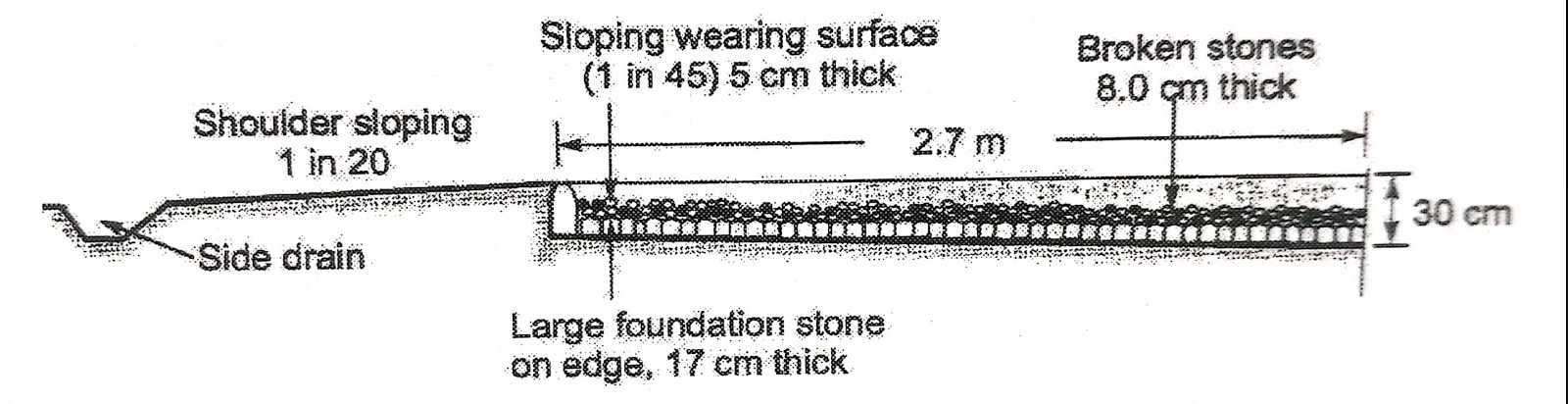
3. Tresaguet Construction: For many centuries after the Romans, no new road construction methods were developed. Then in 1764 AD, a French engineer named Pierre Tresaguet introduced a cheaper and improved method of building roads. His design was based on better knowledge of soil conditions and drainage. He only needed 30 cm of road thickness, which was much less than Roman roads. He prepared the ground and laid large foundation stones on their edges. At the sides, he placed larger stones to act as kerbs. Smaller stones were packed tightly between the gaps and compacted. On top of this, a layer of smaller stones was added and sloped from the center to the edges (1 in 45) to allow rainwater to drain off. Even the shoulders of the road were sloped to help drain water into side ditches. This method marked the beginning of modern road construction.
4. Telford Construction: Thomas Telford began his work in the early 19th century in England. He believed in using heavy foundation stones placed above a prepared soil base (subgrade) to make roads strong and durable. He also emphasized the importance of creating a definite cross slope on the road surface to allow rainwater to drain off easily. This slope was achieved by varying the thickness of the foundation stones, making the stones thinner at the edges and thicker towards the center of the road.
The main features of his construction are:
- Preparing a level subgrade to the designed width, usually about 9 meters wide.
- Placing foundation stones of lesser thickness (about 17 cm) near the edges and stones of increasing thickness (up to 22 cm) towards the center to create the cross slope.
- Filling the gaps between the large foundation stones with smaller stones and compacting them tightly.
- Covering the central portion (about 5.5 meters wide) with two layers of angular broken stones, compacted to thicknesses of 10 cm and 5 cm.
- Adding a top wearing course of 4 cm thick gravel for a smooth, durable surface.
- Finishing the road surface with a cross slope of about 1 in 45 for proper drainage.

5. Macadam Construction
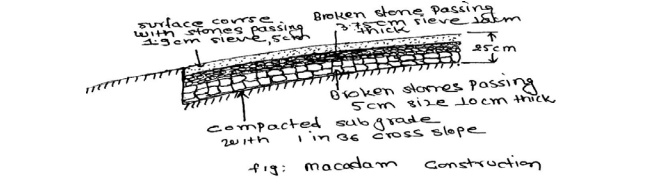
John Macadam, a Scottish road builder, is considered the pioneer of modern road construction. He was the first to understand the importance of draining the soil beneath the road (subgrade drainage) as well as draining water from the road surface itself. Macadam also realized that using a very thick base was unnecessary if hard and strong stones were used properly. He suggested that the total thickness of the road pavement should be just about 25 centimeters.
Construction Steps
- The subgrade (soil beneath the road) is first compacted and shaped with a cross slope of 1 in 36 (meaning the road surface slopes gently from the center to the edges) to the desired width.
- The first layer of the road consists of strong broken stones that can pass through a 5 cm sieve. This layer is compacted evenly to a thickness of 10 cm.
- The second layer uses smaller broken stones, about 3.75 cm in size, and is also compacted to a thickness of 10 cm.
- The top or final layer consists of very small stones, less than 2 cm in size, compacted to about 5 cm thick. The surface is finished so that the cross slope remains about 1 in 36 to allow water to drain off properly.
Modern Roads
All modern roads are improvements of the old Macadam construction method. Instead of using soil to bind the stones on the road surface, modern roads use bituminous binders (like tar or asphalt), which make the surface stronger and more durable.
There are two main types of modern pavements:
- Flexible pavements, which have layers of bituminous materials that can bend and flex under heavy traffic.
- Rigid pavements, which are made from cement concrete and are very strong and hard.
Examples of Modern Roads
- Roads with surface dressing: These roads have a top layer made of bitumen with small stones spread on it, and different granular materials below for support.
- Bituminous-bound macadam roads: These use bitumen as a binder instead of soil, making the road surface waterproof and durable.
- Asphalt concrete roads: Made by mixing bitumen with fine and coarse aggregates to form a smooth, strong surface.
- Cement concrete roads: Made from a mixture of cement, sand, and gravel, which hardens to form a solid and rigid surface.
Road patterns
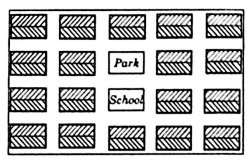
1) Rectangular or Block pattern: Rectangular or Block pattern. In this pattern, the whole area is divided into rectangular blocks of plots, with streets intersecting at right angles. The main road, which passes through the centre of the area, should be sufficiently wide, and other branch roads may be comparatively narrow. The main road provides a direct
approach to the outside of the city
2) Radial or Star and block Pattern:
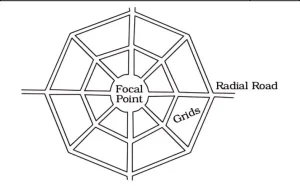
In the Radial or Star Pattern, roads spread outward from a central point like the spokes of a wheel, helping connect the center to the outer areas directly. In the Block Pattern, roads are arranged in straight lines crossing each other at right angles to form square or rectangular blocks, making navigation simple and dividing the area into neat sections.
3. Hexagonal Pattern

In the Hexagonal Pattern, roads are laid out to form hexagon-shaped blocks, with each block having six sides. This pattern allows roads to connect at multiple angles, providing more route options and smooth traffic flow. It uses land efficiently and reduces sharp turns compared to square blocks.
Classification of road :
Road Classification is the system of grouping roads into different categories based on their purpose, importance, and the type of traffic they carry. Generally, roads are classified as:
Based on Different Weather Conditions
Based on different Weather conditions, Roads can be categorized into two types. These are all-weather roads and fair-weather roads.
1. All-Weather Roads:
- These roads are designed for use throughout the year, regardless of rain or dry seasons.
- They are properly surfaced with materials like bitumen, concrete, or stone.
- Good drainage is provided to prevent waterlogging.
2. Fair-Weather Roads:
- These roads can only be used during dry seasons.
- They may become muddy and impassable during heavy rain.
- Usually found in rural or low-traffic areas with low construction costs.
B). Road Classification Based on Pavement / Carriageway
Roads can also be classified by the type of pavement or carriageway surface they have:
Paved Roads (Surfaced Roads):
- These roads have a hard, smooth surface like bitumen, asphalt, or concrete. They provide good riding quality and can handle heavy traffic. Examples: National Highways, Expressways, Urban Main Roads.
Unpaved Roads (Unsurfaced Roads):
- These roads have no proper surfacing; they are made of soil, gravel, or earth. Suitable for light or local traffic in rural areas. Examples: Village roads, temporary farm roads.
C.)Based on the type of pavement surfacing
Based on the type of pavement surfacing, roads are classified as surfaced roads and unsurfaced roads.
1. Surfaced Roads: Surfaced roads are provided with a proper bituminous or cement concrete layer, which makes them smooth, durable, and suitable for all-weather use and heavy traffic.
2. Unsurfaced Roads: Unsurfaced roads do not have any bituminous or concrete surfacing; they are usually made of natural soil, gravel, or stones and are mainly used in rural areas where traffic is light. These roads may not be usable during rainy seasons as they can become muddy and difficult to drive on.
D) Classification of Urban Roads
Urban roads are roads located within cities and towns, and they are classified based on their function and the type of traffic they carry. The main types are:
Sub-Arterial Roads: These roads connect arterial roads to collector streets and help distribute traffic between main roads and local streets.
Collector Streets: These roads collect traffic from local streets and direct it to sub-arterial or arterial roads. They provide access to residential areas, markets, and small business zones.
Local Streets: These are minor roads that provide direct access to individual houses, buildings, and local facilities. They carry low traffic at low speeds.
Road Classification According to Nepal Road Standard 2070
- Administrative Classification
Administrative classification of roads is intended for assigning national importance and the level of government responsible for overall management and methods of financing. According to this classification, roads are classified into:
1. National Highways
2. Feeder Roads
3. District Roads and
4. Urban Road
1. National Highways
National Highways are main roads connecting East to West and North to South of the Nation. These serve directly the greater portion of the longer distance travel, provide a consistently higher level of service in terms of travel speeds, and bear the inter-community mobility. These roads shall be the main arterial routes passing through the length and breadth of the country as a whole.
2. Feeder Roads
Feeder roads are important roads of localized nature. These serve the community’s wide interest and connect District Headquarters, Major economic centres, and Tourism centres to National Highways or other feeder roads.
3. District Roads
District Roads are important roads within a district serving areas of production and markets, and connecting with each other or with the main highways.
4. Urban Roads
Urban Roads are the roads serving within the urban In Nepal the overall management of National Highways and Feeder Roads comes within the responsibility of the Department of Roads (DOR). These roads are collectively called the Strategic Roads Network (SRN). District Roads and Urban Roads are managed by the Department of Local Infrastructure Development and Agricultural Roads (DOLIDAR). These roads are collectively called the Local Roads Network (LRN). municipalities.
Technical/Functional Road Classification
For the purpose of assigning appropriate geometric and technical design parameters, roads are classified into the following categories:
Class I
These are the highest standard roads, typically expressways, featuring divided carriageways and full access control. They are designed to handle an Average Daily Traffic (ADT) of 20,000 Passenger Car Units (PCU) or more over a 20-year design horizon.
Design Speed (Plain Terrain): 120 km/h
Class II
This category includes roads with an ADT ranging between 5,000 and 20,000 PCU over a 20-year period.
Design Speed (Plain Terrain): 100 km/h
Class III
Roads in this class are designed for an ADT of 2,000 to 5,000 PCU over a 20-year perspective.
Design Speed (Plain Terrain): 80 km/h
Class IV
These are roads with an ADT of less than 2,000 PCU over a 20-year design period.
Design Speed: Varies depending on terrain and local conditions.
Compiled by Er. Basant Kumar Yadav