
Introduction to the Source of Water
The source of water is that place from which water can be extracted for various purposes. This unit focuses on the various sources of water. Introduction to rainwater, surface water, and groundwater. Explanation about the criteria to be adopted while selecting a source for a water supply scheme has also been given here. Furthermore, it provides the idea to measure the yield of the source.
Sources of water
Water comes from the three main sources: Rainwater, Underground water, and Surface water. Rainwater includes rain, snow, and other forms of precipitation. Underground includes water tables and water hidden in the soil. Surface water includes oceans, rivers, lakes, ponds, and any other above-ground collection of water. The various sources of water are briefly described below.
1. Rainwater
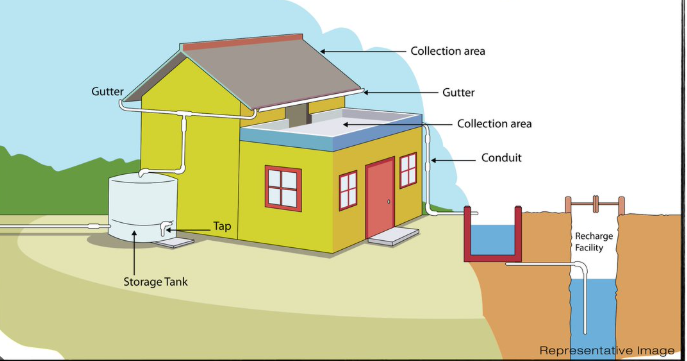 The evaporated water from large water bodies like the sea, ocean, river etc. condensed at high altitude in the form of clouds and when it falls below the dew point, it starts falling in the form of rain, hails, dew, frost etc. During its fall from high altitude to ground, it absorbs oxygen, carbon dioxide, and other gases along with dust, smoke, fumes, bacteria, etc. Therefore, rainwater may contain a large amount of impurities. The quantity of impurities is maximum in the first rain and minimum in the last season’s rains.
The rain water can be collected in following ways,
- The roof of the houses: Water is stored in small underground tank or cistern, for small individual supply.
2. From prepared catchment: The surface of catchments is made impervious by suitable lining material, and a suitable slope is given so that water is stored in moderate-sized reservoirs. This water is used for communal supplies, mostly for drinking purposes. The quality of rainwater falling on the open land is better than that falling on cities or towns. The quality of rainwater from the last season is usually good and can be used after little treatment.
Surface source of water
The water, which is available on the surface of the earth, is known as the surface source of water, and the source containing that surface water is termed as a surface source. Surface sources of water include rivers, streams, lakes, ponds, etc. There large variation in the water yield of the surface source, which may vary from season to season. The following are the main surface sources of water.
- Streams
- Rivers
- Lakes
- Ponds
- Impounded reservoirs
1. Streams:
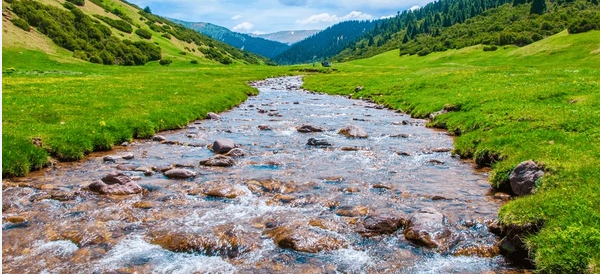
Streams are made when rainwater flows down mountains and hills. During the rainy season, streams have more water than in other times of the year. Some streams only have water in the rainy season and dry up in summer; these are called “Raining Streams.”Usually, the water in streams is clean, but the first rainwater may carry dirt and small particles like sand and clay. Sometimes, after heavy rain, the stream water can have more dirt and other dissolved substances in it. As the quantity of water in the stream is not more, streams can be used as a source of water supply only for a small village after giving the necessary treatment.
2.Rivers:
Rivers are large, natural streams of flowing water that usually start in mountains or hills. They are formed when rainwater, melting snow, or springs come together and flow downhill. Rivers move across land, passing through valleys, forests, and cities, and usually end by flowing into a sea, ocean, or lake.
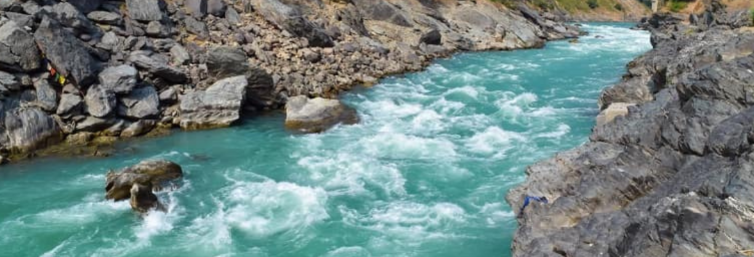
Rivers are very important for people, animals, and plants. They provide fresh water for drinking, farming, and industry. Many people also use rivers for transportation, fishing, and producing electricity through dams. The water in rivers is mostly clean at the source, but it can become polluted as it flows through towns and cities.
3.Lakes :
In mountains at some places, natural basins are formed with impervious beds. Water from springs and streams generally flows towards these basins and lakes are formed. The quantity of water in the lakes depends on its basin capacity, catchments area, annual rainfall porosity of ground etc.
The quality of large lakes is better than that of the small lakes. The lake, which is situated at high altitudes, contain almost pure water, which can be used without any treatment.
4.Pound:
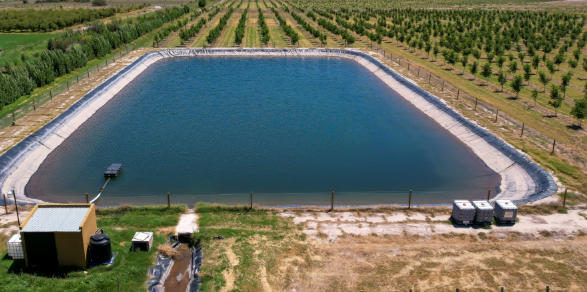
Ponds are low-lying areas where water collects, especially during the rainy season. They are similar to lakes but are usually found in flat plains. Ponds can be man-made for specific purposes like irrigation or fish farming, or they may form naturally as a result of activities such as digging for building construction, road embankments, or brick making. Generally, the amount of water in ponds is small and contains many impurities, so it is not suitable for drinking or water supply. However, pond water can be used for activities like washing clothes, bathing animals, and other similar purposes.
5. Impended Reservoirs
It is found that there is great variation in the quantity of water in the river in the monsoon and the summer season. In some rivers, the flow become very small and cannot meet the requirement of hot weather. In such cases, it become essential to store the excess water of monsoon to for summer season. The water can be stored in the river by constructing a weir or a dam across the river at suitable location. The reservoir thus formed is known as impounded reservoir.
Ground water
The water, which is found below the surface of the earth, is known as underground water and the source containing such water is known as underground source of water.
The main source of ground water is precipitation. A portion of precipitation enter the surface of the earth. The entrance of rain water into the ground is known a infiltration and the movement of this water after infiltration is known as percolation. A portion of rainfall percolates into the ground and is stored as a ground water at hard (impervious) stratum. The ground water reservoir consists of water held in voids within a soil stratum. Sometimes this ground water percolates through the soil and appears again at surface in the form of spring. Alternatively, this stored water below the earth surface can be taken out by some suitable arrangement like construction of well and tube well. The following are the main underground sources of water:
- Springs
- Wells
1. Springs
A spring is any natural situation where water flows from an aquifer to earth surface. Ground water is stored in aquifers, which are underground water reservoirs. They contain billions of gallons of water. Sometimes this water reappears at the ground surface in the form of spring. A spring is formed when the pressure in aquifer causes the water to flow at the surface.
Generally spring are formed under following circumstances,
- When the surface of earth drops sharply below the normal water table.
- When, due to an impervious obstruction the ground water is collected in the form of reservoir and forces the water to overflow at the surface.
- When fissure in impervious stratum allows artesian water to flow in the form of spring.
Spring generally can supply small quantity of water; hence, these cannot be used as a source of water to big towns. Good developed springs can be used as a water supply source for small towns. Normally the quality of water in the spring is good and little treatment is enough before supplying.
2.Wells:
Wells are the vertical hole or shaft excavated in the earth for bringing ground water to the surface. Wells are mainly divided into two types, they are
a) Open wells or Dug wells
b) Bored or Drilled wells or Tube well
a) Open wells or Dug wells:
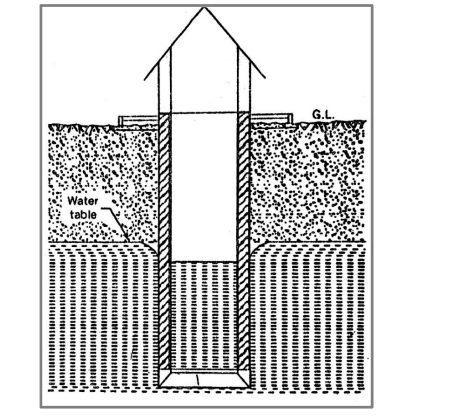
These are shallow wells, which are usually confined to soft ground, sand and gravel to intercept water form topmost water bearing stratum. These wells are suitable for small discharge of about 20 cu.m/hour. Open wells are constructed mostly in circular shape, diameter of which may be between 1 to 4 m and depth may be up to 20m.The walls of these wells may be constructed with precast R.C.C. blocks, bricks or stone masonry.
- Dug wells are very cheap in construction
- Yield of open well is low, because they receive water from top unconfined aquifer only.
b. Tube well :
The discharge available from the ordinary open well is very low. Due to their low yield, open wells are only useful for small locality or for private building. For obtaining more yield, nowadays tube-wells are commonly used.
A tube well is long pipe sunk into the ground with the strainer, which allows water to pass through but prevents sand from coming along with water. Because of the strainer, water can be taken out from aquifer at high velocity without any danger of
soil particles being carried away with water. These wells receive their yield from large number of aquifers; hence, their discharge capacity is much more than ordinary open wells.
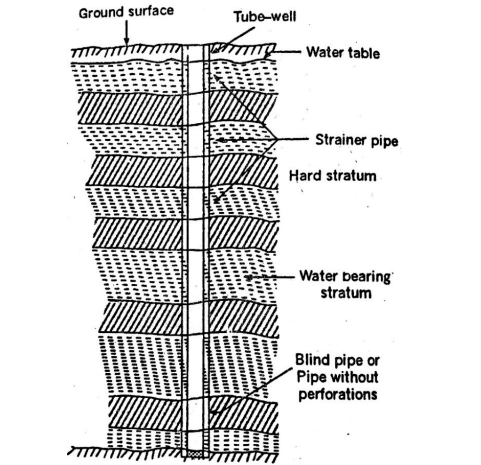
- A tube well consists of long special pipe with strainer, installed deep below the surface of earth to tap water from various water layer.
- The depth of tube well may vary from 50 to 500m.
- The maximum yield of tube well may be up to 200 liter/second
- The yield of average tube well is 50litre/second
- Tube discharge more water than open well this is because tube well receive their supply from more than one water layer but open well get supply from only top layer of underground water.
- The quality of water from tube well is much better than open well as they drew their supplies from deep.
Compiled by Er. Basant kumar yadav
Introduction to the Source of Water
The source of water is that place from which water can be extracted for various purposes. This unit focuses on the various sources of water. Introduction to rainwater, surface water, and groundwater. Explanation about the criteria to be adopted while selecting a source for a water supply scheme has also been given here. Furthermore, it provides the idea to measure the yield of the source.
Sources of water
Water comes from the three main sources: Rainwater, Underground water, and Surface water. Rainwater includes rain, snow, and other forms of precipitation. Underground includes water tables and water hidden in the soil. Surface water includes oceans, rivers, lakes, ponds, and any other above-ground collection of water. The various sources of water are briefly described below.
1. Rainwater
The evaporated water from large water bodies like the sea, ocean, river etc. condensed at high altitude in the form of clouds and when it falls below the dew point, it starts falling in the form of rain, hails, dew, frost etc. During its fall from high altitude to ground, it absorbs oxygen, carbon dioxide, and other gases along with dust, smoke, fumes, bacteria, etc. Therefore, rainwater may contain a large amount of impurities. The quantity of impurities is maximum in the first rain and minimum in the last season’s rains.
The rain water can be collected in following ways,
- The roof of the houses: Water is stored in small underground tank or cistern, for small individual supply.
2. From prepared catchment: The surface of catchments is made impervious by suitable lining material, and a suitable slope is given so that water is stored in moderate-sized reservoirs. This water is used for communal supplies, mostly for drinking purposes. The quality of rainwater falling on the open land is better than that falling on cities or towns. The quality of rainwater from the last season is usually good and can be used after little treatment.
Surface source of water
The water, which is available on the surface of the earth, is known as the surface source of water, and the source containing that surface water is termed as a surface source. Surface sources of water include rivers, streams, lakes, ponds, etc. There large variation in the water yield of the surface source, which may vary from season to season. The following are the main surface sources of water.
- Streams
- Rivers
- Lakes
- Ponds
- Impounded reservoirs
1. Streams:
Streams are made when rainwater flows down mountains and hills. During the rainy season, streams have more water than in other times of the year. Some streams only have water in the rainy season and dry up in summer; these are called “Raining Streams.”Usually, the water in streams is clean, but the first rainwater may carry dirt and small particles like sand and clay. Sometimes, after heavy rain, the stream water can have more dirt and other dissolved substances in it. As the quantity of water in the stream is not more, streams can be used as a source of water supply only for a small village after giving the necessary treatment.
2.Rivers:
Rivers are large, natural streams of flowing water that usually start in mountains or hills. They are formed when rainwater, melting snow, or springs come together and flow downhill. Rivers move across land, passing through valleys, forests, and cities, and usually end by flowing into a sea, ocean, or lake.
Rivers are very important for people, animals, and plants. They provide fresh water for drinking, farming, and industry. Many people also use rivers for transportation, fishing, and producing electricity through dams. The water in rivers is mostly clean at the source, but it can become polluted as it flows through towns and cities.
3.Lakes :
In mountains at some places, natural basins are formed with impervious beds. Water from springs and streams generally flows towards these basins and lakes are formed. The quantity of water in the lakes depends on its basin capacity, catchments area, annual rainfall porosity of ground etc.
The quality of large lakes is better than that of the small lakes. The lake, which is situated at high altitudes, contain almost pure water, which can be used without any treatment.
4.Pound:
Ponds are low-lying areas where water collects, especially during the rainy season. They are similar to lakes but are usually found in flat plains. Ponds can be man-made for specific purposes like irrigation or fish farming, or they may form naturally as a result of activities such as digging for building construction, road embankments, or brick making. Generally, the amount of water in ponds is small and contains many impurities, so it is not suitable for drinking or water supply. However, pond water can be used for activities like washing clothes, bathing animals, and other similar purposes.
5. Impended Reservoirs
It is found that there is great variation in the quantity of water in the river in the monsoon and the summer season. In some rivers, the flow become very small and cannot meet the requirement of hot weather. In such cases, it become essential to store the excess water of monsoon to for summer season. The water can be stored in the river by constructing a weir or a dam across the river at suitable location. The reservoir thus formed is known as impounded reservoir.
Ground water
The water, which is found below the surface of the earth, is known as underground water and the source containing such water is known as underground source of water.
The main source of ground water is precipitation. A portion of precipitation enter the surface of the earth. The entrance of rain water into the ground is known a infiltration and the movement of this water after infiltration is known as percolation. A portion of rainfall percolates into the ground and is stored as a ground water at hard (impervious) stratum. The ground water reservoir consists of water held in voids within a soil stratum. Sometimes this ground water percolates through the soil and appears again at surface in the form of spring. Alternatively, this stored water below the earth surface can be taken out by some suitable arrangement like construction of well and tube well. The following are the main underground sources of water:
- Springs
- Wells
1. Springs
A spring is any natural situation where water flows from an aquifer to earth surface. Ground water is stored in aquifers, which are underground water reservoirs. They contain billions of gallons of water. Sometimes this water reappears at the ground surface in the form of spring. A spring is formed when the pressure in aquifer causes the water to flow at the surface.
Generally spring are formed under following circumstances,
- When the surface of earth drops sharply below the normal water table.
- When, due to an impervious obstruction the ground water is collected in the form of reservoir and forces the water to overflow at the surface.
- When fissure in impervious stratum allows artesian water to flow in the form of spring.
Spring generally can supply small quantity of water; hence, these cannot be used as a source of water to big towns. Good developed springs can be used as a water supply source for small towns. Normally the quality of water in the spring is good and little treatment is enough before supplying.
2.Wells:
Wells are the vertical hole or shaft excavated in the earth for bringing ground water to the surface. Wells are mainly divided into two types, they are
a) Open wells or Dug wells
b) Bored or Drilled wells or Tube well
a) Open wells or Dug wells:
These are shallow wells, which are usually confined to soft ground, sand and gravel to intercept water form topmost water bearing stratum. These wells are suitable for small discharge of about 20 cu.m/hour. Open wells are constructed mostly in circular shape, diameter of which may be between 1 to 4 m and depth may be up to 20m.The walls of these wells may be constructed with precast R.C.C. blocks, bricks or stone masonry.
- Dug wells are very cheap in construction
- Yield of open well is low, because they receive water from top unconfined aquifer only.
b. Tube well :
The discharge available from the ordinary open well is very low. Due to their low yield, open wells are only useful for small locality or for private building. For obtaining more yield, nowadays tube-wells are commonly used.
A tube well is long pipe sunk into the ground with the strainer, which allows water to pass through but prevents sand from coming along with water. Because of the strainer, water can be taken out from aquifer at high velocity without any danger of
soil particles being carried away with water. These wells receive their yield from large number of aquifers; hence, their discharge capacity is much more than ordinary open wells.
- A tube well consists of long special pipe with strainer, installed deep below the surface of earth to tap water from various water layer.
- The depth of tube well may vary from 50 to 500m.
- The maximum yield of tube well may be up to 200 liter/second
- The yield of average tube well is 50litre/second
- Tube discharge more water than open well this is because tube well receive their supply from more than one water layer but open well get supply from only top layer of underground water.
- The quality of water from tube well is much better than open well as they drew their supplies from deep.
Compiled by Er. Basant kumar yadav