Data Representation
Data representation refers to the way we organize, store, and transfer information. To store data digitally, we can use devices such as computers, smartphones, or tablets. Once the data is stored, electronic circuits are used to manage and process it, allowing it to be accessed or transmitted when needed.
Data
Data can be anything, such as numbers, names, music notes, or colors in a photo.
Digitization
Digitization is the process of converting information like photos, music, numbers, or text into a digital format. Electronic devices are used to work with this digital data.
Binary Digits
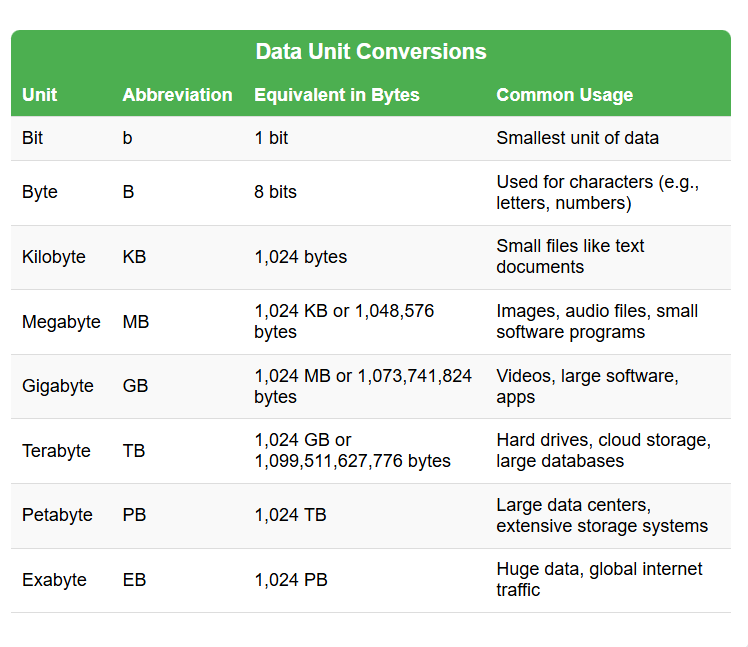
Binary digits, or bits, are the basic units of digital data, represented by 0 and 1. These bits are used to store information in computers. The values 1 and 0 represent on/off or true/false. A digital file is a simple file that stores data on devices like flash drives, CDs, hard disks, or DVDs.
Binary Numbers Representation
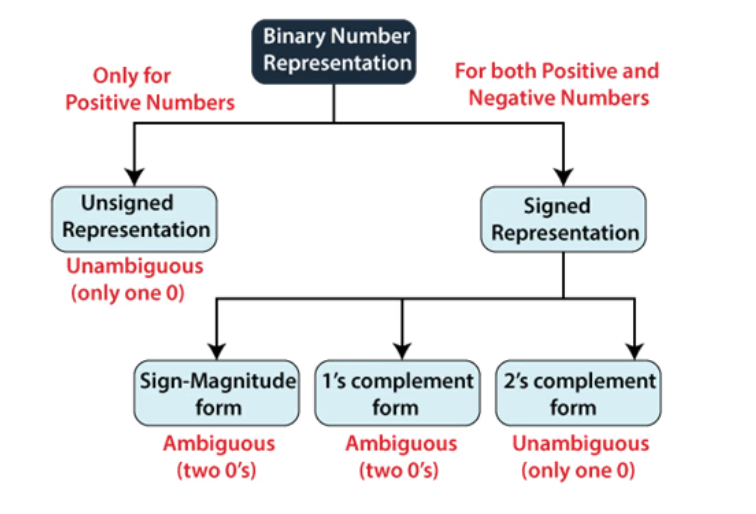
Our computer can understand only (0, 1) language. The binary numbers are represented in both ways, i.e., signed and unsigned. The positive numbers are represented in both ways- signed and unsigned, but the negative numbers can only be described in a signed way. The difference between unsigned and signed numbers is that unsigned numbers do not use any sign bit for positive and negative numbers identification, but signed numbers use.
Unsigned Numbers
Unsigned numbers always represent positive values, as they don’t have a sign bit for negative numbers. By default, decimal numbers are assumed to be positive. In unsigned binary representation, the value is determined by its magnitude, with zero always being positive. This unambiguous representation technique ensures each number has only one unique binary form. The range of unsigned binary numbers is from 0 to 2n−12^n – 1, where nn is the number of bits.
Example: Represents the decimal number 102 in an unsigned binary number.
To represent the decimal number 102 in unsigned binary: Divide 102 by 2 and keep
track of the quotient and remainder.
25 ÷ 2 = 12 (remainder = 1)
12 ÷ 2 = 6 (remainder = 0)
6 ÷ 2 = 3 (remainder = 0)
3 ÷ 2 = 1 (remainder = 1)
1 ÷ 2 = 0 (remainder = 1)
Read the remainders from bottom to top: 102 (decimal) = 1100110 (binary) So, 102 in unsigned binary is 1100110.
Signed Number representation for binary Number:
Signed number representation in binary is a method used to represent both positive and negative numbers in a binary system. Since binary digits (bits) naturally represent only 0 and 1, special methods are needed to encode the sign of a number. There are several common methods for representing signed numbers:
1. Sign-Magnitude Representation: a number is represented as an 8-bit or 16-bit combination where left most bit (MSB- most significant bit) is represented as sign bit and the rest bit is the magnitude bit.

- In 8-bit representation (1 bit for sign and 7 bits for magnitude)
- In 16–bit representation (1 bit for sign and 15 bits for magnitude), if the MSB is 0, the number is PositiveIf the MSB is 1, the number is Negative.
Example (8-bit):
+13→00001101-13→10001101
Another Example :
+36 = 0 1100100
-45 = 1 0101101
+117 = 0 1110101
-117 = 1 1110101
But, this technique is not proper because there is no proper system to represent negative numbers.
2. One’s Complement representation : In this technique, a negative number is obtained by taking the complement of its positive counterpart.Example
+45 = 0 0101101 : Complement each binary digit for a negative value
– 45 = 1 1010010
But this technique is not well defined and meaningful because the representation of -0 and +0 is different from as So, another technique is adopted that is universal for all numbers.
3. Two’s Complement Representation : The Two’s Complement method is the most widely used technique for representing signed binary numbers in computers. It solves the problem of two different zeros found in the One’s Complement.
Example: +45 and -45 representation with 8 bits
+45= 00101101 Take one’s complement and 1 to the one’s complement.
-45= 11010010+1 = 11010011
Fixed and Floating-Point Number
In digital technology, data is stored in memory registers using binary bits 0s and 1s because a computer only understands the binary language.
When we enter data into the system, it is converted into binary bits, which are then processed and used in the CPU in different ways. Memory registers have specific formats and ranges to store data. To represent real numbers efficiently in memory (8-bit, 16-bit, 32-bit, or higher registers), scientists have developed two main approaches:
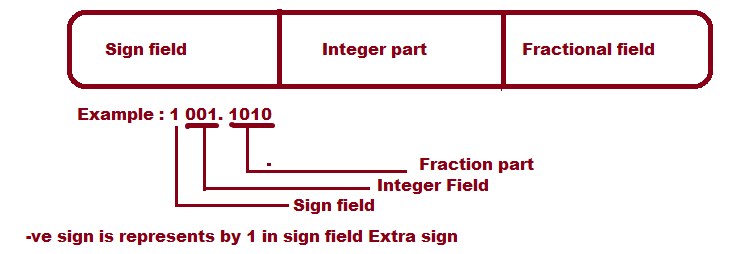
Fixed Point Representation: In computer architecture, fixed point representation is used to represent a binary number by using the following methods: The smallest binary number or decimal number is 0000.0001 & highest is 9999.9999 in decimal and 1111.1111 in binary.