
CAPACITOR
The charge holding capacity of a body is called capacitance or capacity. The bodies that are especially designed for storing charges are called capacitors. Basically, a capacitor has two conducting surfaces separated by an insulating medium called a dielectric.

Capacitance of a capacitor:
If q is the charge stored in a capacitor when its potential difference is V,
q ∝ V
or, q=CV
The proportionality constant C is called the capacitance of the capacitor. Its value does not depend on the material of the plates. The capacitance of the capacitor is a function of the nature of the dielectric medium.
Unit of capacitance:

The capacitance of a capacitor is said to be 1 Farad if its potential difference rises by one volt when a charge of 1 coulomb (C) is applied to it.
Factors determining the capacitance of a capacitor
- The area of the metallic plates of the capacitor.
- The distance between the metallic plates.
- The permittivity of the insulating medium (or dielectric).
Capacitance of an isolated sphere:
Let us consider an isolated charged sphere of radius RR and charge qq. The potential at any point on the surface of the sphere is:
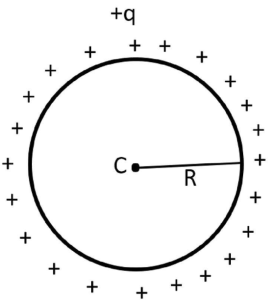
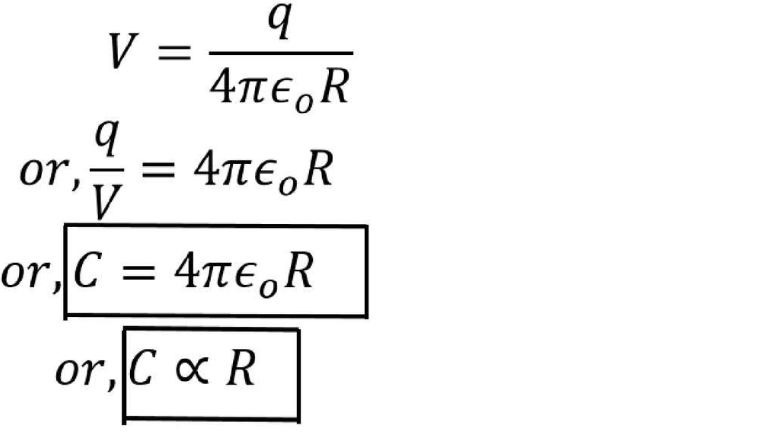
Capacitance of a parallel plate capacitor: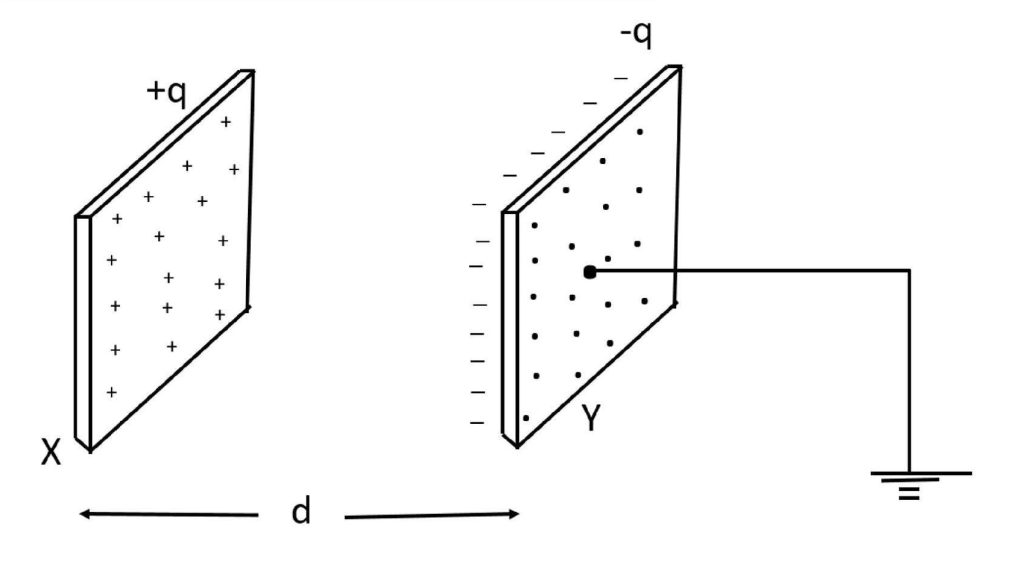
Consider a parallel plate capacitor X and Y with dielectric between them separated by a distance . The plate X is given a positive charge, and the plate Y is earthed. The plate X is given a positive charge, due to which a negative charge is induced in plate Y by induction. As a result, a uniform electric field is set up between the plates.
Now,
Electric field, E =σ/ϵ0, where is the surface charge density of each plate. The plates are assumed to be in a vacuum.

If the capacitor is kept in a medium of dielectric constant K:

The capacitance increases with the presence of dielectrics.The capacitance of a parallel plate capacitor is,
(i) Directly proportional to the permittivity of the dielectric.
(ii) Directly proportional to the area of the plate.
(iii) Inversely proportional to the distance between the plates of the capacitor.
Combination of Capacitance
When two or more capacitors are connected together in an electric circuit, the total or equivalent capacitance can be different from the individual capacitances. This arrangement of capacitors is called a combination of capacitance.
There are mainly two types of combinations of capacitors:
1.Series Combination

The capacitors C1, C2, C3,…, are connected in series with a battery as shown in the figure. In a series combination, the charges across each capacitor are the same () whereas the potential differences across each capacitor are different, as shown in the figure.
The net potential difference across the combination is V


2. Parallel Combination:

Three capacitors of capacitances C1, C2, and C3 are connected in parallel as shown in the figure. The charge supplied by the battery gets distributed among different capacitors. In a parallel combination, the charges across each capacitor are different, whereas the potential across each capacitor is the same.
Now,
q=q1+q2+q3

Energy Stored in a Capacitor:
When a capacitor is connected to a battery, it is charged and the charge sets up an electric field in the capacitor. For the battery to charge the capacitor further, it has to do work against the electric field set up in the capacitor. The work done by the battery is stored in the capacitor as its electric potential energy.

The capacitance of a capacitor is C. At any instant of time, the charge stored in the capacitor is q when the potential difference across it is V. Then,
q=CV
If the battery supplies a small amount of charge dq at potential V, the small work done by the battery is:
dW=V dq
The total work done by the battery in charging the capacitor from 0 to q:


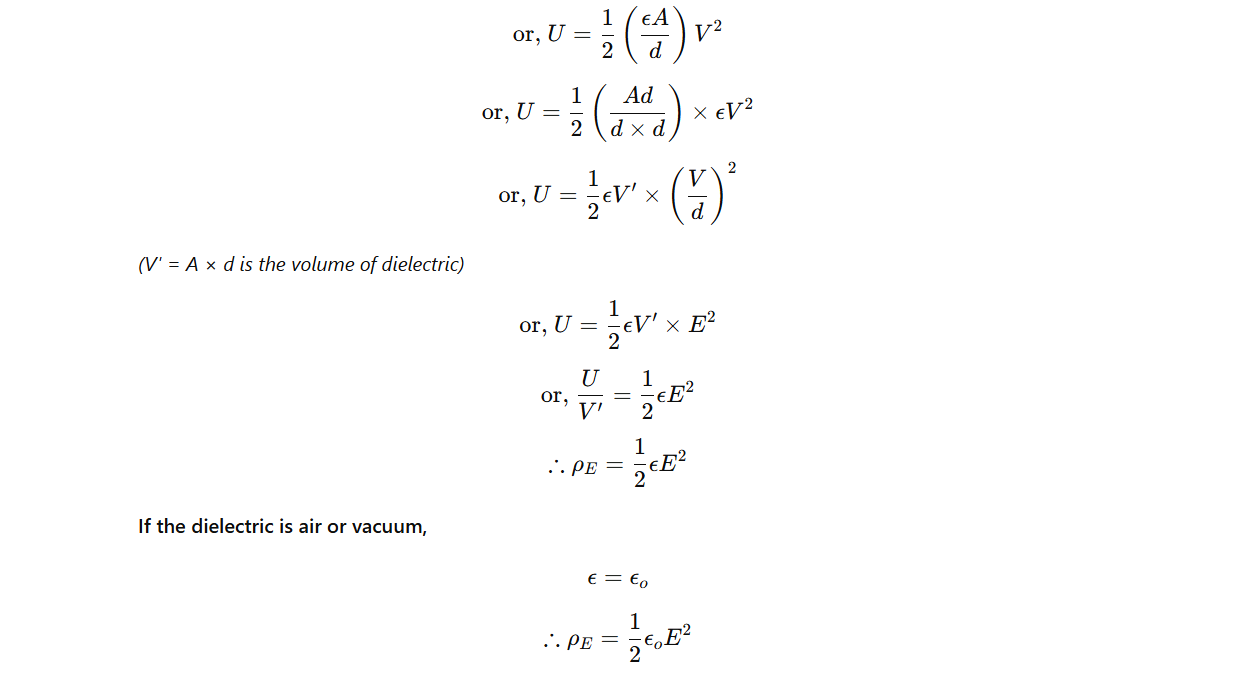
Energy Density (ρE)
The energy density (ρE) of a dielectric medium in an electric field is defined as the energy stored in a unit volume of the dielectric.
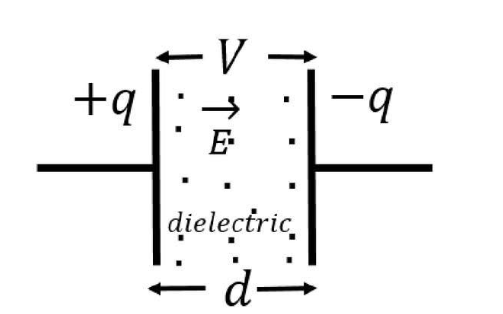

NUMERICALS
1. A 300 V battery is connected across capacitors of 3μF and 6μF in parallel. Calculate the energy stored in each capacitor.

2. Two large parallel metal plates carry opposite charges. They are separated by 10 cm, and a P.D. of 500 volts is applied on them. (a) What is the magnitude of the electric field strength between them? Compute the work done by this field on a charge of 2×10⁻⁹ C as it moves from higher to lower potential?

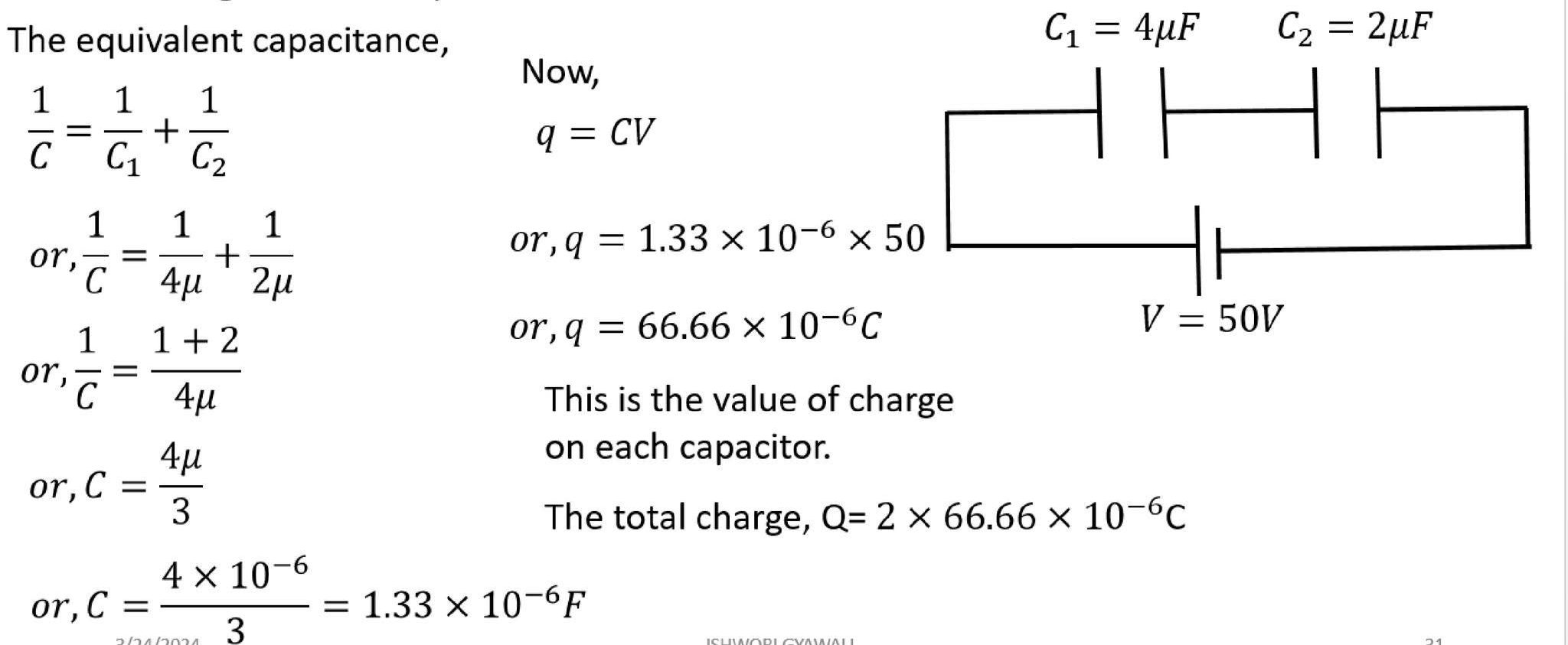
3. Two capacitors of capacitances 4μF and 2μF respectively are joined in series with a battery of emf 50 volts. The connections are broken, and the like terminals of the capacitors are joined. Find the final charge on each capacitor.
Compiled By: Er. Basant Kumar Yadav