
Introduction to Polymorphism
C++ Polymorphism is one of the four fundamental concepts of Object-Oriented Programming (OOP). It allows the same function, interface, or operation to behave differently depending on the object or situation. In C++, polymorphism is mainly classified into compile-time polymorphism and runtime polymorphism. Compile-time polymorphism includes function overloading and operator overloading, while runtime polymorphism is commonly implemented using virtual functions and function overriding.
In this complete C++ polymorphism tutorial, you will learn the definition, types, syntax, practical programs, virtual functions, function overriding, pure virtual functions, abstract classes, advantages, common mistakes, and frequently asked interview questions. The examples are designed for beginners, students, and anyone preparing for C++ programming exams or interviews.
Advantages of Polymorphism
- Polymorphism allows the same method or function to be used for different objects, which reduces repeated code.
- It makes programs easier to update and maintain because changes can be done in one place.
- It increases flexibility because the same code can work in different situations.
- It reduces code complexity by avoiding duplicate methods and keeping the program simple.
- It improves readability because similar tasks use the same method name.
- It supports extensibility, so new features or classes can be added easily without changing much existing code.
- It saves development time because reusable code makes programming faster and easier.
Types of Polymorphism
Polymorphism is mainly divided into two types: Compile-time Polymorphism and Run-time Polymorphism.
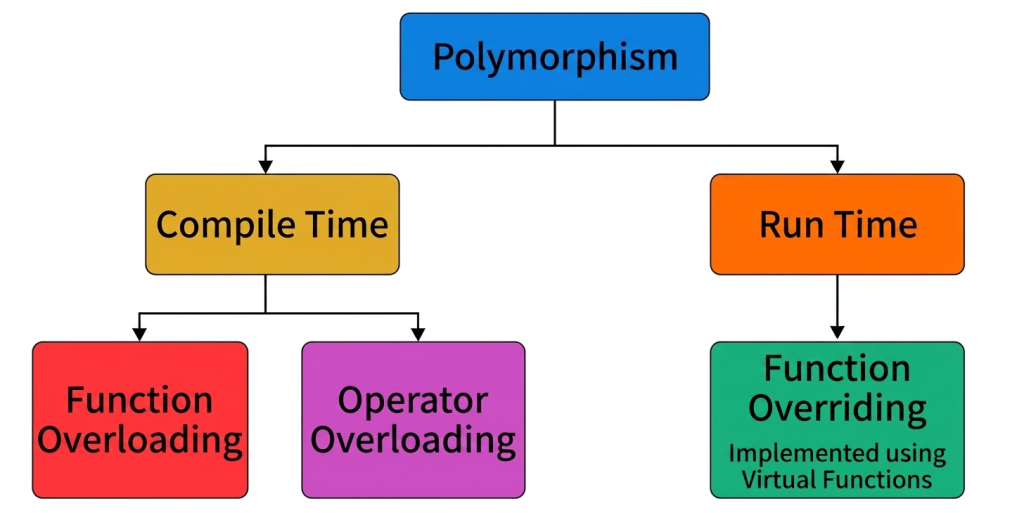
1 Compile-time Polymorphism:
Compile-time Polymorphism is also called Static Polymorphism. In this type, the method to be called is decided at the time of compilation. It is achieved using method overloading. In method overloading, multiple methods have the same name but different parameters. The compiler decides which method to use based on the arguments. It is faster and easier to implement.
Types of Compile-time Polymorphism
Compile-time polymorphism is mainly achieved in two ways:
a. Method Overloading or Function Overloading
Method overloading is a type of compile-time polymorphism where multiple methods have the same name but different parameters. These parameters can differ in number, type, or order. The compiler decides which method to call based on the arguments passed during compilation. It helps in improving code readability and reusability. For example, an add() method can be used to add two numbers or three numbers by changing parameters.
Example of Function Overloading:
#include <iostream>
using namespace std;
class Calculator {
public:
int add(int a, int b) {
return a + b;
}
int add(int a, int b, int c) {
return a + b + c;
}
};
int main() {
Calculator obj;
cout << obj.add(10, 20) << endl;
cout << obj.add(10, 20, 30) << endl;
}
b. Operator Overloading
Operator overloading is another type of compile-time polymorphism where operators are given different meanings based on the operands. It allows operators like +, -, *, etc., to work with user-defined data types such as objects. The compiler determines the correct operation during compilation. It makes code more intuitive and easier to understand. For example, the An + operator can be used to add two complex numbers or to concatenate strings.
Example of Operating Overloading:
#include <iostream>
using namespace std;
class Complex {
public:
int real, imag;
Complex(int r, int i) {
real = r;
imag = i;
}
Complex operator + (Complex obj) {
Complex temp(0, 0);
temp.real = real + obj.real;
temp.imag = imag + obj.imag;
return temp;
}
};
int main() {
Complex c1(2, 3), c2(4, 5);
Complex c3 = c1 + c2;
cout << c3.real << " + " << c3.imag << "i" << endl;
}
Rules for Operator Overloading
- Only existing operators can be overloaded; we cannot create new operators.
- The meaning of an operator can be changed only for user-defined data types (like classes).
- At least one operand must be a user-defined type (object of a class).
- We cannot change the basic meaning of operators for built-in data types (like int, float).
- Some operators cannot be overloaded such as
::,.,.*,?:,sizeof. - Operator overloading does not change the number of operands an operator takes.
- The precedence and associativity of operators cannot be changed.
- Overloaded operators must follow the syntax rules of the programming language (like C++).
2 Run-time Polymorphism
Run-time Polymorphism is also called Dynamic Polymorphism. In this type, the method to be called is decided at the time of program execution. It is achieved using method overriding. In method overriding, a child class provides a specific implementation of a method that already exists in the parent class. The decision is made during runtime based on the object. It is more flexible but slightly slower than compile-time polymorphism.
Run-time polymorphism mainly has one important type:
A. Method Overriding or Function Overriding.
Method overriding is a type of run-time polymorphism in which a child class provides its own implementation of a method that already exists in the parent class. The method in the child class has the same name, same parameters, and same return type as the parent class method. When the program runs, the decision of which method to execute is made at run time based on the object. If the object is of the child class, the child class method is called instead of the parent class method. This helps in achieving flexibility and reusability in programming. It is widely used in object-oriented programming languages like Java and C++.
Example of Run-Time Polymorphism (Method Overriding)
#include <iostream>
using namespace std;
class Animal {
public:
void sound() {
cout << "Animal makes sound" << endl;
}
};
class Dog : public Animal {
public:
void sound() {
cout << "Dog barks" << endl;
}
};
int main() {
Animal *a; // parent class pointer
Dog d; // child class object
a = &d; // pointing child object
a->sound(); // run-time decision
}
Comparison between Compile-Time and Run-Time Polymorphism.
| Compile-Time Polymorphism | Run-Time Polymorphism |
|---|---|
| Also called static polymorphism | Also called dynamic polymorphism |
| Method is decided at compile time | Method is decided at run time |
| Uses method overloading | Uses method overriding |
| Uses early binding | Uses late binding (dynamic binding) |
| Faster in execution | Slightly slower in execution |
| Less flexible | More flexible |
| Easier to implement | More complex to implement |
| Inheritance is not required | Inheritance is required |
Comparison between Function Overloading and Function Overriding
| Function Overloading | Function Overriding |
|---|---|
| It is a compile-time polymorphism | It is a run-time polymorphism |
| Occurs in the same class | Occurs in parent and child classes |
| Methods have the same name but different parameters | Methods have the same name and same parameters |
| Return type may or may not be same | Return type is usually same or covariant |
| Decided by the compiler | Decided at run time |
| Inheritance is not required | Inheritance is required |
| Also called static binding | Also called dynamic binding |
| Improves code readability | Provides specific implementation in child class |
Virtual Functions
A virtual function is a member function in a base (parent) class that is declared using the keyword virtual and is meant to be overridden in a derived (child) class. It is mainly used to achieve run-time polymorphism (dynamic binding) in object-oriented programming.
When a virtual function is used, the program decides at run time which function to call based on the object type, not the pointer or reference type. This allows the same function call to behave differently for different objects.
Virtual functions help make programs more flexible and powerful because they allow the child class to provide its own specific implementation of a function defined in the parent class.
Simple Example (C++)
#include <iostream>
using namespace std;
class Animal {
public:
virtual void sound() {
cout << "Animal sound" << endl;
}
};
class Dog : public Animal {
public:
void sound() override {
cout << "Dog barks" << endl;
}
};
int main() {
Animal *a;
Dog d;
a = &d;
a->sound(); // calls Dog's function (run-time decision)
}