Gravitation
Gravitation is the universal force of attraction between any two masses, such as the Earth and the Sun, or even a table and a chair. It is explained by Newton’s Law of Universal Gravitation.
It is the weakest of the four basic forces (gravitational, electromagnetic, strong, and weak) in nature. But it is the most significant force as it governs the motion of the planets, controls the structure of galaxies, and has played a key role in the formation and evolution of stars and the universe itself.
Gravity:-
Gravity is a special case of gravitation. When one of the bodies is the Earth, the gravitational force is called gravity. It is the attractive force between the Earth and any object on or near its surface.
Note: Free fall:- Motion of a body under the influence of gravity alone is called free fall. In fact, true free fall occurs only in a vacuum (no air resistance).
Acceleration due to gravity (g):-
It is defined as the acceleration produced in a freely falling body under Earth’s gravitational pull and is denoted by ‘g’. It is a vector quantity directed towards the centre of the Earth. It does not depend on the mass, size, or shape of the body. The value of g is constant at a given place.However, it varies slightly with altitude, depth, the rotation of the Earth, and the shape of the Earth.
Note: The value of g is independent of the nature and mass of a body at a given place, i.e., its magnitude is the same for all bodies.
Newton’s Law of Gravitation
Statement: Every particle attracts every other particle with a force which is directly proportional to the product of their masses and inversely proportional to the square of the distance between their centres. This force of attraction acts along the line joining the centres of the two particles.
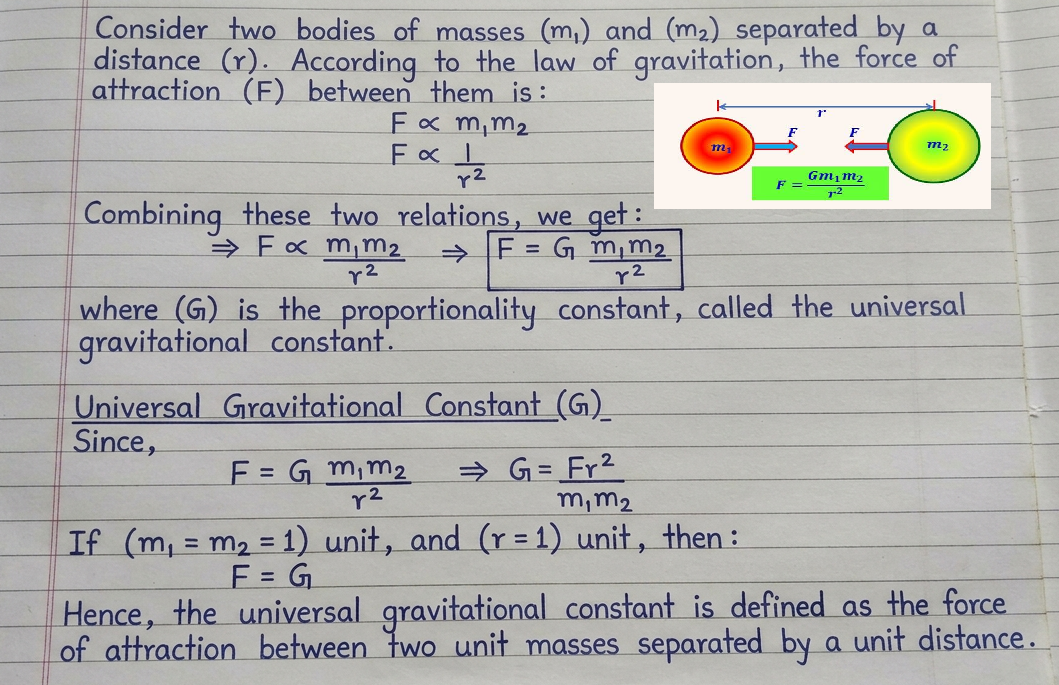
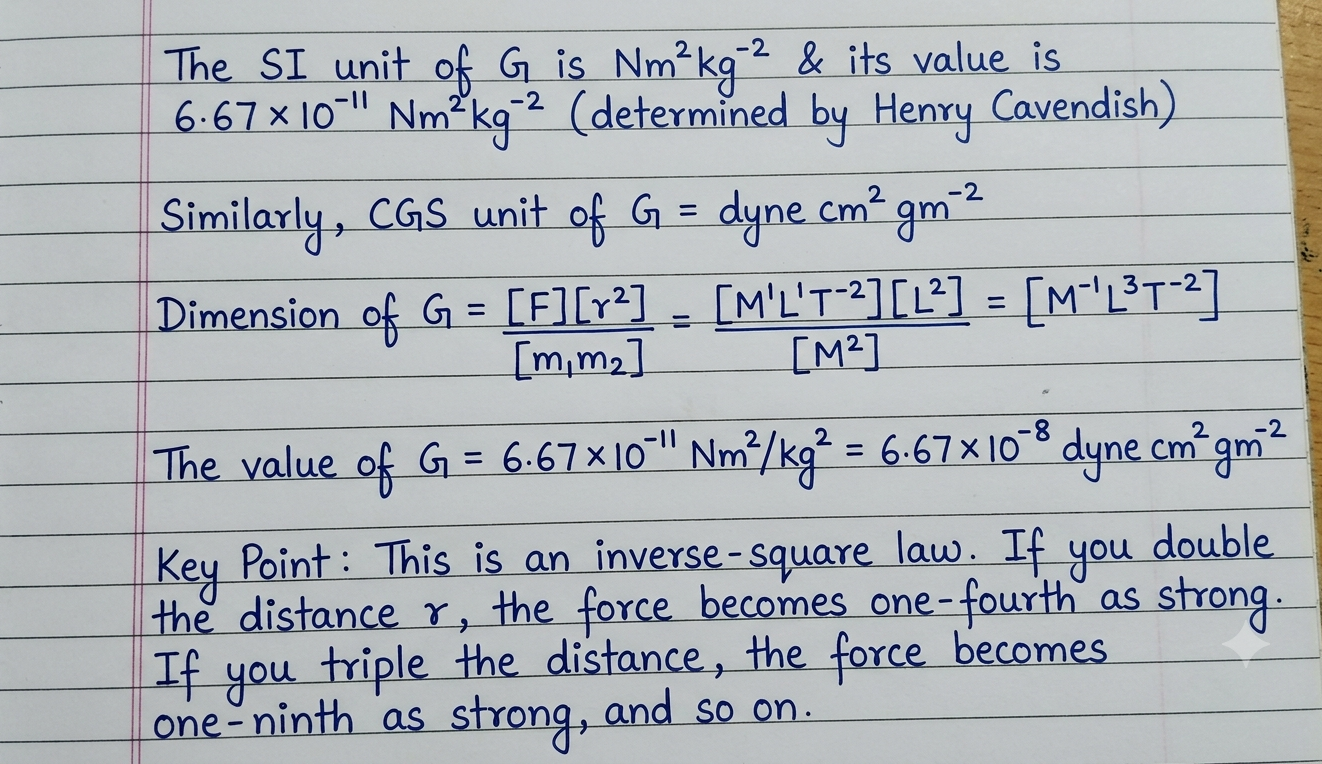
Characteristics of Gravitational Force:
- The gravitational force is independent of the material or medium between the two masses.
- The force always acts along the line joining the centers of the two masses; hence, it is called a central force.
- The gravitational force is conservative in nature; the work done by it depends only on the initial and final positions, not on the path taken.
- The force exerted by one body on the other is equal in magnitude and opposite in direction to the force exerted by the second body on the first (obeys Newton’s Third Law).
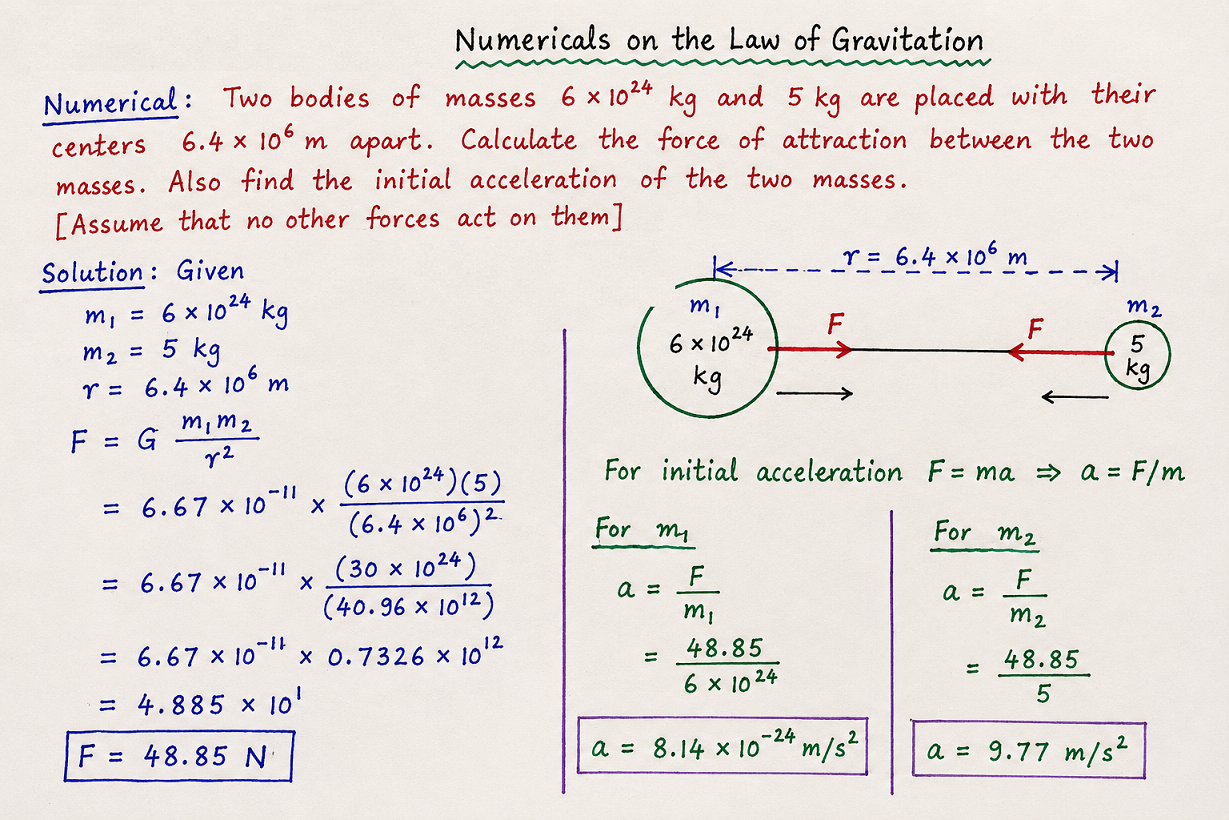
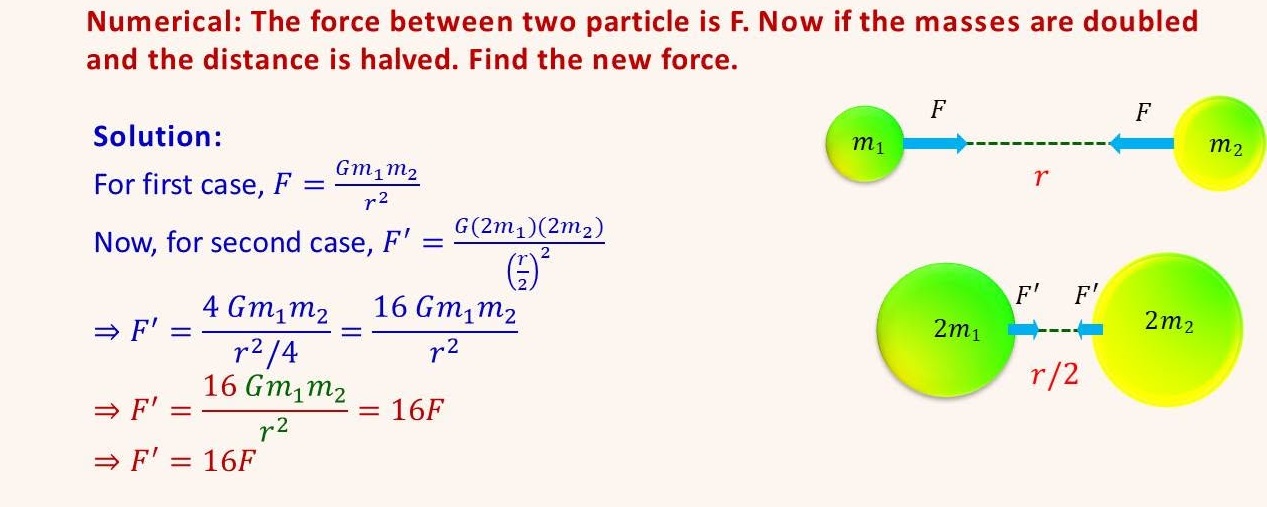
Numericals on the Law of Gravitation