Electricity is a fundamental aspect of modern life, powering our homes, businesses, industries, and technology. It’s a form of energy resulting from the movement of charged particles, typically electrons, through a conductor. Understanding the basics of electricity is important to understanding how various electrical systems work and how to use them safely and effectively.
Key Concepts:
Atoms and Charges: Atoms, the building blocks of matter, consist of protons (positively charged), neutrons (no charge), and electrons (negatively charged). An electric charge is created when electrons move from one atom to another. Materials can be classified as conductors, insulators, or semiconductors based on their ability to conduct electricity.
Voltage (V)
Voltage is the force or “push” that drives electric charges to move through a circuit. It’s measured in volts and symbolized by “V”. In other words, Voltage is the electric potential difference between two points in a circuit. It is the force that pushes electric current through a conductor. Voltage is measured in volts (V).
Current (I):
Current is the flow of electric charge through a conductor. It’s measured in amperes (amps) and symbolized by “I”. In other words, Current is the flow of electric charge through a conductor. It is measured in amperes (A). Current flows from the positive to the negative terminal in a circuit.
Resistance (R):
Resistance is the property of a material or component that restricts the flow of electric current, converting some of the electrical energy into heat. It depends on factors like the material’s properties, length, and cross-sectional area. The unit of resistance is the ohm (Ω). The relationship is described by Ohm’s Law: V=IR
Ohm’s Law:
The voltage across a conductor is directly proportional to the current passing through it, given that the temperature remains constant. Ohm’s Law describes the relationship between voltage, current, and resistance in an electrical circuit:
V= IR…………………(I)
Where:
V is the voltage across the circuit (in volts), and I is the current flowing through the circuit (in amperes). R is the resistance of the circuit (in ohms).
Electric Circuits:
An electric circuit is a closed path through which electric current flows. It typically consists of a power source (like a battery), conductors (wires), a load (like a bulb), and a switch. The current flows from the positive terminal of the source, through the circuit, and back to the negative terminal. For the circuit to work, it must be complete (closed).
Series Circuit:
A series circuit is an electric circuit in which components are connected one after another in a single path. The same electric current flows through all the components. If one component stops working, the whole circuit stops working. The total resistance of the circuit is found by adding the resistance of all components.
Parallel Circuit
A parallel circuit is an electric circuit in which components are connected between the same two points. This creates more than one path for electric current to flow. Each component receives the same voltage. If one component stops working, the other components continue to work. The total resistance becomes lower when more components are added to the circuit.
Power:
Power is the rate at which electrical energy is transferred by an electric circuit. It’s measured in watts (W) and can be calculated using the formula:
Power = v*I …………………..(2)
Static Electricity:
Static electricity happens when positive and negative charges become unbalanced on an object. This can happen due to friction, induction, or conduction. When charges collect on an object, they create static electricity. This can cause attraction or repulsion between objects. It may also create sparks or small electric shocks.
A simple example of static electricity is rubbing a balloon on your hair. Electrons move from your hair to the balloon. The balloon becomes negatively charged, and your hair becomes positively charged. Opposite charges attract each other. As a result, the balloon sticks to your hair or a wall for a short time.
Dynamic Electricity:
Dynamic electricity can be defined as the flow of electric charge through a conductor, typically in the form of an electric current. This flow of charge can occur in various forms, including direct current (DC) and alternating current (AC). In DC, the electric charge flows consistently in one direction, while in AC, the direction of the charge alternates periodically.
Dynamic electricity powers much of modern technology and infrastructure, including electrical appliances, lighting systems, motors, and electronics. It is the basis for electrical circuits and is governed by principles described by Ohm’s law and other electrical laws and theories.
Applications and uses of electricity :
Electricity has become an integral part of modern life, powering numerous devices, systems, and industries. Here are some key applications and uses of electricity:
Electricity is used in many parts of daily life. It provides light through bulbs, fluorescent tubes, and LED lights in homes, offices, streets, and public places.
Electricity is also used for heating and cooling. It powers heaters, air conditioners, heat pumps, and electric radiators to maintain comfortable temperatures.
In transportation, electric vehicles use electricity to run their motors. This helps reduce the use of fossil fuels and supports cleaner transportation.
Electricity is important for communication. Devices such as telephones, computers, smartphones, and the Internet use electricity to connect people and share information.
Electricity also supports entertainment. Televisions, radios, gaming consoles, and audio systems use electricity for fun and recreation.
In industries, electricity powers machines and equipment to manufacture different products such as vehicles, electronics, and textiles.
Electricity is used in healthcare. Medical devices such as MRI machines, X-ray machines, defibrillators, and electrocardiographs depend on electricity for diagnosis and treatment.
Electricity is useful in cooking. Electric stoves, ovens, microwaves, and other kitchen appliances make food preparation easier.
In agriculture, electricity helps with irrigation, greenhouse lighting, ventilation, and running farming machines, increasing productivity and efficiency.
Atom:
Atoms are the basic building blocks of all matter. Each atom has a center called the nucleus, which contains protons and neutrons, and it is surrounded by tiny negatively charged electrons. The way these electrons are arranged decides the atom’s mass, charge, and how it reacts with other substances.
Atoms are composed of three subatomic particles: protons, neutrons, and electrons. Protons and neutrons are found in the nucleus at the center of the atom, while electrons orbit the nucleus in electron shells or energy levels.
Proton :
A proton is a positively charged particle found in the nucleus of an atom. It has a charge of +1 and a mass of approximately 1 atomic mass unit (amu). The number of protons in an atom determines its atomic number and identity.it is denoted by (p+)
Neutron:
A neutron is a neutral particle found in the nucleus of an atom. It has no electric charge and a mass nearly equal to that of a proton. Neutrons help stabilize the nucleus by balancing the repulsive forces between protons.. Neutrons have no charge.
Electrons:
An electron is a negatively charged particle that orbits the nucleus of an atom. It has a negative charge and a very small mass compared to protons and neutrons. Electrons are responsible for forming chemical bonds and conducting electricity. it is denoted by (e–)
The charge on an electron is 1.6×10⁻¹⁶ c.
Atomic weight:
The total weight of an atom is known as atomic weight. In other words, an atomic weight can be defined as the average weight of an element with respect to all its isotopes and their relative abundance. Atomic weight is measured in AMU or Dalton.
Atomic Number:
The atomic number can be defined as the total number of protons present in the uncles of an atom is called the atomic number. The total number of protons and neutrons present in the nucleus of an atom is called the mass number.
Electric charge:
Electric charge can be defined as the amount of charge transferred from one body to another body through different models, such as conductors, induction, and specific methods. Electric charge can be categorized into two types, and these are positive electric charge and negative charge. The SI unit of electric charge is coulomb C.
Coulomb’s law:
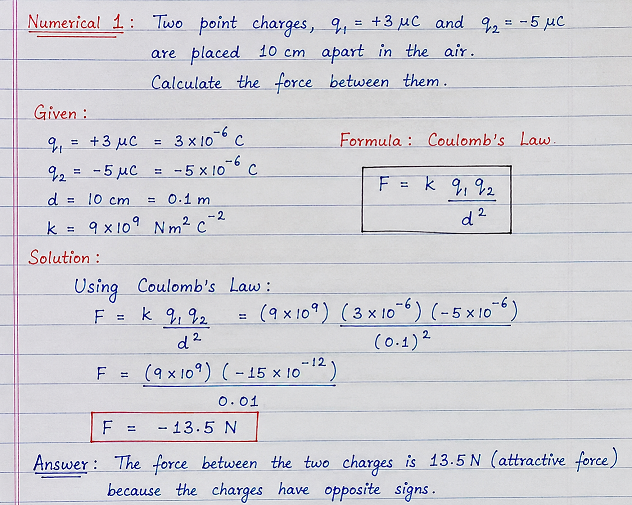
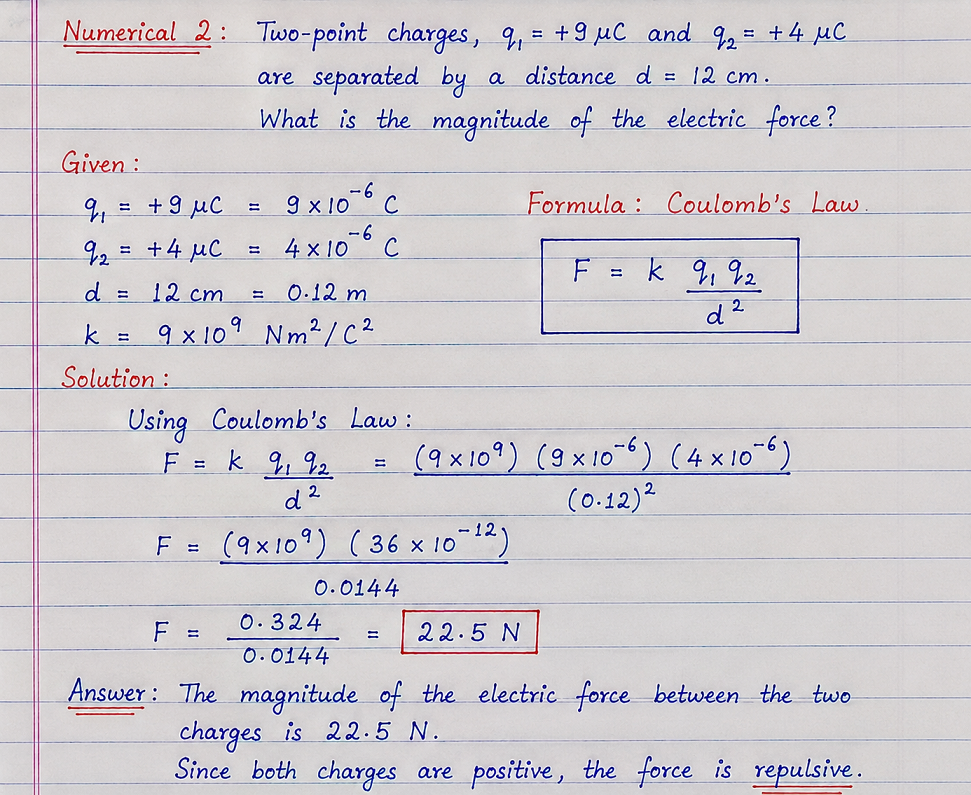
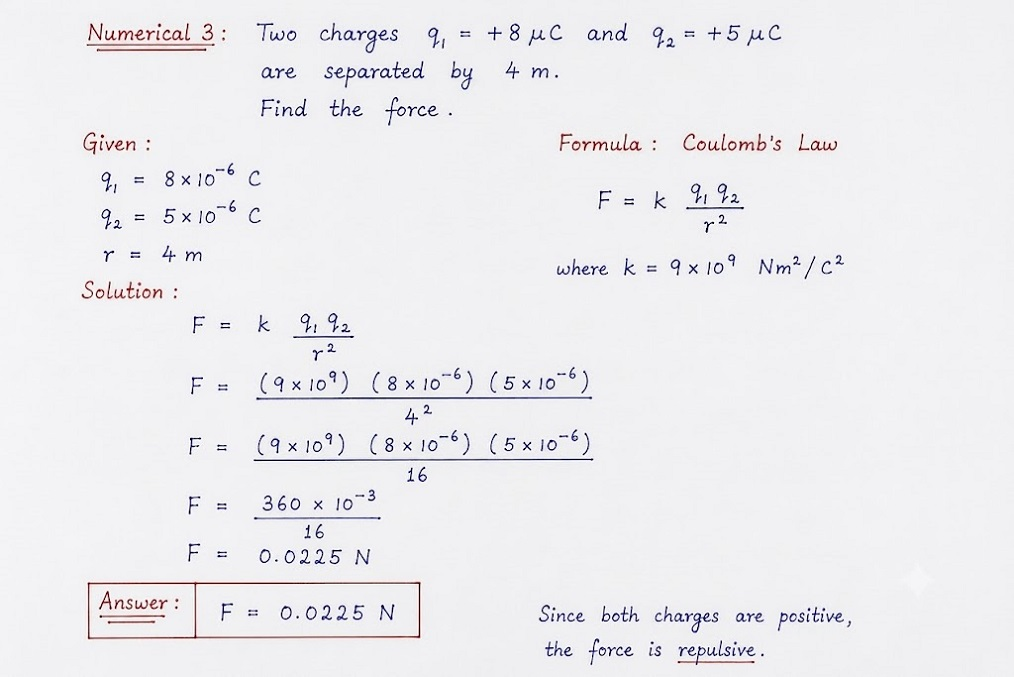
Coulomb’s law states that the force of attraction or repulsion between two charges is directly proportional to the product of charges and inversely proportional to the square of the distance between the charges.
Let us consider two charges having magnitudes Q1 and Q2, which are separated by a distance of d meters, as shown below in diagrams
Mathematically, Coulomb’s law can be expressed as.
F ∝ Q1 *Q2 …………………………(1)
F ∝ 1/d2 …………………………..(2)
Now combining equations 1 and 2, we have
F =( k Q1 * Q2 )/ d2 …………………..(3)
Where:
F is the electrostatic force between the charges,
k is Coulomb’s constant (8.9875×10⁹ N m2/C28.9875×109N m2/C2),
Q1 and Q2 are the magnitudes of the charges,
d is the distance between the charges.
Equation 3 is known as Coulomb’s law in mathematical form.
An electric field is a region around a charged particle or object. Charged particles exert attractive forces on each other when their charges are opposite, and repulse each other when their charges are the same. The formula of the electric field is given as,
E = F /Q
Where,
E is the electric field.
F is the force.
Q is the charge.
Electric Potential:
An electric potential (also called the electrostatic potential) is the amount of electric potential energy that a unit Electric Flux: electric flux. the electric field potential or charge would have at any point in space, and is equal to the work done by an external agent in carrying a unit of positive charge from the arbitrarily chosen reference point (usually infinity) to that point without any acceleration.
An electric potential is the amount of work energy needed per unit of electric charge to move the charge from one place to another in an electric field. An electric potential is also called an electric field or electrostatics potential and is measured in volts.
Electric Potential Difference
An electric potential is the work done per unit charge to move a unit charge from one point to another in an electric field. Electric potential difference is also known as voltage, and electric potential difference is usually known as voltage difference, and its SI unit is volt.
Electric Energy:
Electric energy is the energy generated by the movement of electrons from one point to another. Generally, electrical energy is referred to as the energy that has been converted from electric potential energy. Electric potential energy is measured in joules or watt-hours.
Sources of Electrical Energy:
The prime sources of electrical energy include renewable sources renewable sources like solar and wind, and nonrenewable sources like fossil energy fuels and nuclear power.
1. Hydropower:
Hydropower is the main source of electrical energy in Nepal. Electrical energy is created from water stored in huge dams. The energy created by the water released from these dams is transformed into electricity by hydroelectric turbines and generators. Hydropower is the generation of electricity using the energy of moving water. Water from rivers or dams flows through turbines, causing them to spin and produce electricity. It is a renewable and clean source of energy. Hydropower plants are often built near water sources like rivers or waterfalls
2. Solar
Solar Generating Electricity
Solar power is the energy generated from sunlight using solar panels.Solar panels contain photovoltaic (PV) cells that convert sunlight directly into electricity. It is a clean, renewable, and eco-friendly source of energy. Solar power reduces dependence on fossil fuels and lowers electricity bills. It works best in areas with strong and consistent sunlight.
3. Wind:
Wind power is the energy generated by converting the wind’s kinetic energy into electricity using wind turbines. When the wind blows, it spins the turbine blades, which drive a generator to produce electricity. Wind power is renewable, clean, and produces no greenhouse gas emissions. It is often used in wind farms located in open or coastal areas with strong winds. Wind energy helps reduce reliance on fossil fuels and supports sustainable power generation.