Calorimetry:
Calorimetry is a branch of physics which deals about the study of quantitative measurement of heat energy exchange (between two bodies in thermal contact).Here, the word Calorimetry is invented from the word ‘Calorie’. i.e. 1Cal. = 4.2 Joule.
Calorimeter:
It is a device which is used to measure the amount of heat exchange. It consists of cylindrical copper vessel provided with stirrer.

Note: Calorimeter is thermally insulated from its surrounding. So, there occurs no heat exchange between calorimeter & its surrounding.
Principle of Calorimetry:
When two bodies at different temperatures are kept in thermal contact, the body at higher temperature loses heat and the body at lower temperature gains heat until they will attain the same temperature i.e thermal equilibrium is attained.
According to the principle of conservation of energy, if there is no exchange of heat with other bodies, the heat lost by the hot body must be equal to the heat gained by the cold body.
Now this principle related to the exchange of heat between two bodies at different temperatures in an insulated system is known as principle of calorimetry. Hence, the principle of calorimetry states that if there is no exchange of heat with the surroundings, heat lost by hot body is always equal to heat gained by cold body.
i.e. heat lost by hot body = heat gained by cold body
This principle is used wherever there is an exchange of heat between bodies.
Heat Equation and Specific Heat Capacity.
If Q be the amount of heat required to change temperature Δθ of given mass m of a body, then it has been found that
Q ∝ m …………………………1
and Q ∝ Δθ………………………2
On combining, equations 1 and 2 we get.
Q = msΔθ
This equation is known as Heat equation. Here, S is a proportionality constant and known as Specific heat capacity of the materials of the body and is given by
Specific heat capacity (S) = Q / (mΔθ) ………………………. (3)
Specific heat capacity of a body (S) can be defined as the amount of heat required to change or increase the temperature of unit mass of the body through one degree. Its unit is J.kg⁻¹K⁻¹ in SI systems of units and Cal.gm⁻¹°C⁻¹ in cgs systems of units. eg. Specific heat capacity of water is 4200Jkg⁻¹K⁻¹ in SI systems of units and 1 Cal.gm⁻¹ °C⁻¹ in Cgs systems of units.
Heat Capacity or Thermal Capacity:
Heat capacity or thermal capacity of a body of given mass is the amount of heat required to raise the temperature of the whole mass of the body through unit temperature difference.
If Q be the amount of heat required to change temperature Δθ of given mass m of a body, then:
Q = msΔθ
Here, for temperature difference Δθ = 1°C (or 1K), then we have:
C = Q
Or, heat capacity (C) = ms ……………………(i)
Where, s: specific heat capacity of substance. This equation (i) is the required expression of heat capacity or thermal capacity of given mass of substance. Its unit is J·K⁻¹ in SI system of units and Cal·°C⁻¹ in CGS system of units.
Water Equivalent of Substance (W)
It is defined as the equivalent mass of water that will absorb or lose the same amount of heat as done by the given mass of substance for the same change (i.e. rise or fall) in temperature. It is denoted by W.
If Q be the amount of heat required to change temperature Δθ of given mass m of a body, then we have:
Q = msΔθ ……………………………(i)
Further, let W represent the water equivalent of a given substance, then Q is given by:
Q = W sₓ Δθ ……………………………(ii)
So, by definition, we can write:
W sₓ Δθ = msΔθ
∴ W = (ms) / sₓ
But, in CGS system: sₓ = 1 Cal·gm⁻¹·°C⁻¹ (for water), then we have:
∴ W = ms = C :In CGS unit
Thus, water equivalent of a substance is numerically equal to its heat capacity or thermal capacity in the CGS system.
Determination of Specific Heat Capacity of Solid by the Method of Mixture: Regnault’s Apparatus
The working of determination of specific heat capacity of solid is based on the principle of Calorimetry (or method of mixture).
Principle:
According to this principle, “if there is no exchange of heat between the system and its surroundings, then heat lost by hot body is always equal to heat gained by cold body.”
i.e. Heat lost by hot body = Heat gained by cold body.

Fig.: Determination of specific heat capacity of solid by method of mixture
Description:
Here, the specific heat capacity of a solid can be determined by the method of mixture using Regnault’s apparatus. This apparatus is used to heat the solid, whose specific heat capacity to be determined. It is done by passing steam through inlet I and pass-out through outlet O.
Also, a calorimeter is also use to mix the hot body (taken out from steam chamber) and cold body (i.e. water + calorimeter vessel). Where, thermometer T₁ is used to measure steady constant temperature of hot solid, but thermometer T₂ is used to measure initial temperature of water + calorimeter as well as final temperature of mixture.
Calculation:
For calculation of specific heat capacity of solid:
Let,
mass of the given solid = mₛ
mass of the calorimeter and stirrer = m𝑐
mass of water and calorimeter = m𝑐w
mass of the water in the calorimeter (m𝑤) = m𝑐w – m𝑐
initial temperature of the water + calorimeter = θ₁ °C
initial temperature of hot solid = θ₂ °C [ θ₁ < θ < θ₂ ]
final temperature of the mixture = θ °C
specific heat capacity of calorimeter = s𝑐 (known)
specific heat capacity of water = s𝑤 (known)
specific heat capacity of given solid = Sₛ (unknown)
Now, using the heat equation, we have:
Total heat lost by hot solid = mₛSₛ (θ₂ – θ)
Also, heat gained by calorimeter = m𝑐s𝑐 (θ – θ₁)
& heat gained by water = m𝑤s𝑤 (θ – θ₁)
∴ Total heat gained by water + calorimeter = m𝑤s𝑤 (θ – θ₁) + m𝑐s𝑐 (θ – θ₁)
= [m𝑤s𝑤 + m𝑐s𝑐] (θ – θ₁)
Then, using the principle of Calorimetry, we have:
heat lost by the solid (temperature falls from θ₂ to θ°C) = heat gained by calorimeter and water (temperature rises from θ₁ to θ°C)
or,
mₛSₛ (θ₂ – θ) = [m𝑤s𝑤 + m𝑐s𝑐] (θ – θ₁)
∴ Sₛ = [ m𝑤s𝑤 + m𝑐s𝑐 ] (θ – θ₁) / mₛ (θ₂ – θ)
All the parameters in RHS of the expression can be measured during the experiment. So we can easily find the value of specific heat capacity of given material of the solid using Regnault’s apparatus by the method of mixture.
Numerical:
1. A copper pot with mass 0.5 kg contains 0.17 kg of water at a temperature of 20°C. A 0.250 kg block of iron at 85°C is dropped into the pot. Find the final temperature assuming no heat loss to the surroundings.
[HSEB 2072]
Given:
Specific heat capacity of copper = 390 J kg⁻¹ K⁻¹
Specific heat capacity of iron = 470 J kg⁻¹ K⁻¹
Specific heat capacity of water = 4190 J kg⁻¹ K⁻¹
Solution:
Given,
Mass of copper pot, mc=0.5 kg
Mass of water taken, mw=0.17 kg
Mass of iron block ms=0.25 kg
Initial temperature of copper pot and water, θ1=20∘C
Initial temperature of iron pot θ2=85∘C
Final temperature of mixture θ=?
Here,
Heat lost by iron block:
 2. A metal of mass 25g and at a temperature of 100°C is dropped into a calorimeter containing 200g of water initially at 20°C. The final temperature is 22°C. Compute the specific heat of the metal if the water equivalent of calorimeter is 10g.
Solution:


3. In an experiment of specific heat of a metal, a 200g block of metal at 150°C is dropped into a calorimeter of mass 270g containing 150cm³ of water at 27°C. The final temperature is 40°C. Calculate the specific heat capacity of the metal.
Newton’s Law of Cooling:
Newton’s Law of Cooling states that “the rate of loss of heat by a liquid is directly proportional to the difference in temperature of the liquid and its surrounding”.
Consider a liquid at temperature θ and the temperature of its surrounding θ₀. Let θ > θ₀, so that the liquid loses heat to its surrounding. If dQ be the loss of heat by the liquid in small time dt, then the rate of loss of heat by the liquid is
dQ./dt
According to Newton’s law of cooling, we have,


Where, K is proportionality constant which depends on nature of liquid and its surface area exposed to the surrounding. Negative sign shows that as time of heat loss ‘t’ increase, the amount of heat ‘Q’ decrease.
If dQ be the amount of heat required to raise the temperature of liquid of mass m through dθ, then
dQ=msdθ…………………….(ii)

Where, C is integration constant. This equation is the equation of straight-line Y = mx + C. So, if we plot the graph of loge(θ−θ0) versus time t, we get a straight line with negative slope which verifies the Newton’s law of cooling.
Limitations:
- It cannot be applied for large difference of temperature between liquid and its surrounding. (generally applicable for temperature difference of 30°C – 35°C)
- It cannot be applied for gas and solid. It is valid only for liquid.
Determination of Specific Heat Capacity of Liquid by the Method of Cooling:
The specific heat capacity of a liquid can be determined by using the principle of Newton’s law of cooling.
Principle:
According to this principle, “when two different liquids are cooled under identical conditions, their rates of cooling are same/equal.” i.e.


Explanations:
Two identical calorimeters A and B of same material are taken and mass of each is measured. Let calorimeter A is filled two third of its volume with water and equal volume of liquid is filled in calorimeter B. The mass of water and liquid are measured. Now two calorimeters are placed inside the constant temperature enclosure and identical conditions are provided. Steam is allowed to circulate through the enclosure.
Initially both calorimeters are heated up to the same temperature. Then they are left to cool up to same temperature and their temperatures are noted at equal interval of time during cooling. The specific heat capacity of liquid is determined as follows:
Observation:
Let, mass of calorimeter A = m1
mass of calorimeter B = m2
Mass of water in A = mw
Mass of liquid in B = ml
Specific heat capacity of calorimeters = Sc
Specific heat capacity of water = Sw
Specific heat capacity of liquid = Sl
Initial temperature of both water and liquid = θ1
final temperature of both water and liquid = θ2
Time taken by water to cool from θ1 to θ2 = t1
Time taken by liquid to cool from θ1 to θ2= t2
Now, total heat lost by water and calorimeter A:
 From Newton’s law of cooling, the rate of cooling of liquid and water are equal under identical conditions:

This is the required expression to determine the specific heat capacity of the liquid.

The graph of temperature vs time for water and liquid are plotted and two cooling curves are drawn as shown in the figure.From the cooling curve, the time of cooling of water and given liquid can be calculated.
Newton’s Law of Cooling: Short Questions:
1. Why do animals eat more during winter? [HSEB Model 2065]
Hint: From Newton’s law of cooling, we have:
 Here, in winter, the difference between the temperature of body (θ) and its surrounding (θ₀) will be more. It makes the rate of loss of heat energy from the body will become large. Hence to compensate/balance the loss of energy, animals eat more during the winter.
2. The flames coming out during metal welding does not burn the body of the person engaged in welding. Why?
Hint: From Newton’s law of cooling, we have:
The difference in temperature of the flames coming out during welding (θ) and the surrounding (θ₀) is high. Due to this reason the rate of loss of heat energy will be so fast that the flames lose their almost all heat before they touch the body of the person engaged in welding and the body of the person engaged in welding does not get burned.
Numerical problem
1. A substance takes 3 minutes in cooling from 50°C to 45°C and takes 5 minutes in cooling 45°C to 40°C. What is the temperature of the surroundings?
How much time will it take to cool this substance from 40°C to 35°C?
[ 2076 Set C ] [ Answer: 35°C, 15 min ]
Average temperature between 50°C and 45°C = (50 + 45) / 2 = 47.5°C
Average temperature between 45°C and 40°C = (45 + 40) / 2 = 42.5°C
Time taken to cool from 50°C to 45°C = 3 min = 180 sec
Time taken to cool from 45°C to 40°C = 5 min = 300 sec
Let θ₀ be the temperature of surrounding. Then from Newton’s law of cooling, rate of heat loss is given by

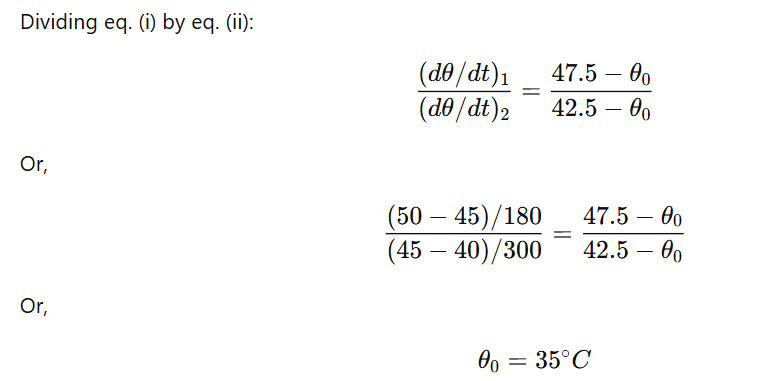
Second part:
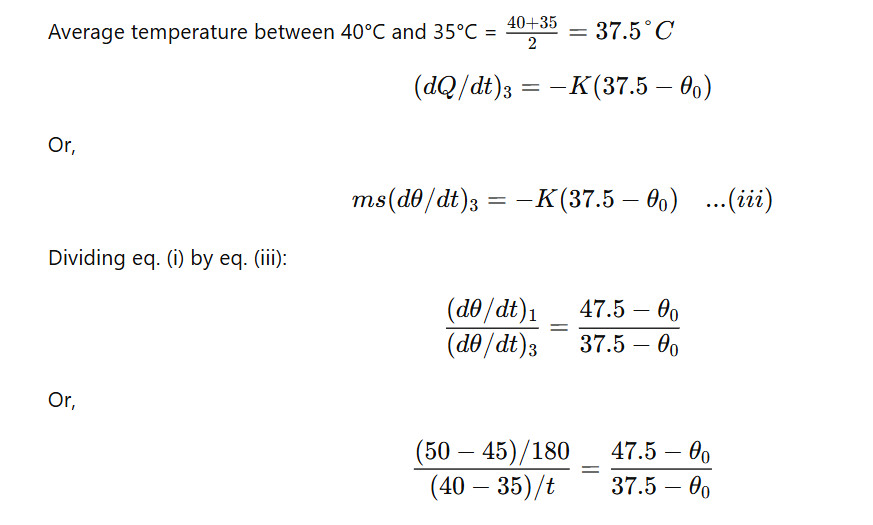
t=15min.
Change of State
Latent Heat
The amount of heat required to convert a substance from one state to another state, keeping temperature constant is known as latent heat.
It has been found that the amount of heat required for change of state at constant temperature is directly proportional to mass of the body
i.e.
Q ∝ m
Q=mL
Where, L is known as latent heat capacity of the body. Its SI unit is J kg⁻¹ and CGS unit is Cal g⁻¹.
If m = 1, then L is called specific latent heat of the substance.
Types of Latent Heat
1. Latent Heat of Fusion
It is defined as the amount of heat required to change unit mass of substance from solid state to liquid state at its constant melting point temperature.
It is denoted by Lᶠ. Latent heat of fusion of ice = 80 cal g⁻¹ = 3.36 × 10⁵ J kg⁻¹
2. Latent Heat of Vaporization
It is defined as the amount of heat required to change unit mass of substance from liquid state to vapour state at its constant boiling point temperature.
It is denoted by Lᵥ. Latent heat of vaporization of water = 540 cal g⁻¹ = 22.68 × 10⁵ J kg⁻¹
Measurement of Latent Heat of Fusion of Ice by the Method of Mixture
Determination of latent heat of fusion of ice is based on the principle of Calorimetry. According to this principle,
“If there is no exchange of heat system and with its surroundings, then heat lost by hot body is always equal to heat gained by cold body.”
i.e.
Heat lost by hot body = Heat gained by cold body

At first, a calorimeter with stirrer is weighed and about two-third part of calorimeter is filled with water. The mass of water is determined by subtracting mass of empty calorimeter with stirrer from mass of calorimeter with stirrer and water.
The initial temperature of water and calorimeter is noted. A piece of melting ice is kept and is mixed with water with the help of stirrer until ice is completely melted. Then, the maximum temperature of mixture is measured.
Finally, the mass of ice is determined by subtracting mass of calorimeter with stirrer and water from total mass of calorimeter with stirrer, water, and ice.
Let,
Mass of calorimeter + stirrer = mc
Mass of calorimeter + stirrer + water = mcw
Mass of water = mcw−mc=mw
Mass of calorimeter + stirrer + water + ice = mcwi
Mass of ice = mcwi -mcw=mi
Latent heat of fusion of ice = Lf
Specific heat capacity of calorimeter = Sc
Specific heat capacity of water = Sw
Initial temperature of calorimeter and water = θ1
Final temperature of mixture = θ
We have,


Measurement of Latent heat of vaporization of water by the Method of Mixture:
Determination of latent heat of vaporization of water is based on the principle of Calorimetry.
According to this principle, “if there is no exchange of heat between system and with its surroundings, then heat lost by hot body is always equal to heat gained by cold body.”
i.e. Heat lost by hot body = Heat gained by cold body

To start with, a calorimeter with a stirrer is weighed and about two third of calorimeter is filled with water. The mass of water is determined by subtracting mass of empty calorimeter and stirrer from total mass of calorimeter, stirrer and water. The initial temperature of calorimeter and water is noted. Some water is boiled separately in a boiler to generate the steam which is then passed to the calorimeter as shown in figure. The steam is left to condense for some time. After a certain time, the supply of steam is stopped. Now, mass of steam is calculated. Finally, the temperature of the mixture is noted.
 Initial temperature of steam = θ₂ = 100°C
Final temperature of mixture = θ


Effect of pressure on melting point:

- Those substances which expand on melting, their melting point increases with increase in pressure. e.g. Wax, phosphorus etc.
- Those substances which contract on melting, their melting point decreases with increase in pressure. e.g. ice, cast iron, bismuth etc.
Regelation:
The phenomenon in which melting of ice takes place when pressure on it is increased and it again solidifies after the removal of extra pressure on it is known as regelation.
S.Q.
1. Explain why two pieces of ice stick when compressed together and released ?
Hints: As we know the phenomenon of regelation in which ice lower its melting point under the application of pressure and thus melted ice freezes back again after the removal of applied pressure on it. So when two pieces of ice are compressed together, the layers of ice in contact melt due to greater pressure but when the applied pressure is removed, releasing the supplied energy in the form of heat to the surrounding the melted ice water again freezes and stick in the form of single piece.
Effect of pressure on boiling point
The boiling point of the substances increases with increase in pressure.
The boiling point of a substance depends on the external pressure and the strength of intermolecular force between the molecules of the liquid.
S.Q.
1. Food cooked in pressure cooker is well cooked than in open pot. Why?
Hints:
On the basis of effect of pressure on boiling point: boiling point of liquid increases with increase in pressure. When food is cooked in pressure cooker, it has got higher pressure inside the vessel during cooking due to greater expansion of air inside the cooker than that of water contained in contact with food inside it. i.e. Water vapour pressure above the surface of water level increases and then boiling point increases.
It is defined as a point in a phase diagram at particular pressure and temperature in which solid, liquid and gaseous state of the substance co-exists.
In other words, the intersection of three curves (i.e. vaporization curve, fusion curve and sublimation curve) in phase diagram is called triple point.
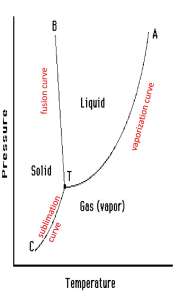
i. vaporization curve:
The vaporization curve represents those points where the liquid and vapour phases are in equilibrium. Thus, it is a graph of boiling point versus pressure.
ii. fusion curve:
The fusion curve represents those points where the liquid and solid phases are in equilibrium. Thus, it is a graph of freezing point versus pressure.
iii. sublimation curve:
The sublimation curve represents those points where the solid and vapour phases are in equilibrium. Thus, it is a graph of sublimation point versus pressure.
Triple point represents a unique temperature and pressure and it is only at this point that the three phases can exist together in equilibrium. For water, the triple point occurs at 0.01°C and 4.58 mm of Hg (i.e. 0.006 atm). Similarly, for CO₂, the triple point occurs at –56.6°C and 5.11 atm.
The Phase Diagrams of H₂O and CO₂

Point out the differences between Boiling and Evaporation
| Boiling | Evaporation |
|---|
| 1) It is rapid and noisy process of converting liquid into vapour state. | 1) It is the slow and silent process of converting liquid into vapour state. |
| 2) It occurs throughout the volume of the liquid. | 2) It occurs at the surface of the liquid. |
| 3) It takes place at a fixed temperature (i.e. only at boiling point). | 3) It can take place at any temperature. |
| 4) No cooling is observed. | 4) Cooling effect is observed. |
