
Definition of Contemporary Technology
Contemporary technology refers to the modern and current technologies that are being developed, used, and improved in today’s world. It includes advanced tools, systems, and innovations that solve present-day problems and make life easier, faster, and more efficient.In simple words, contemporary technology means the latest technology that is shaping our society now.
Examples:
- Artificial Intelligence (AI)
- Robotics
- Cloud Computing
- Cybersecurity
- Internet of Things (IoT)
- Blockchain
- 5G Communication
These technologies are widely used in education, business, healthcare, communication, and industry.
Need of Contemporary Technology
Contemporary technology is needed to solve modern problems, improve efficiency, and support the fast-growing digital world. In today’s world, technology is changing very quickly. Contemporary technology helps individuals, businesses, and governments work more effectively and compete globally.
Main Needs of Contemporary Technology
- Improves Communication
Modern technology like the internet, 5G, and video conferencing allows people to connect instantly across the world. - Increases Efficiency and Productivity
Automation, AI, and advanced software help complete tasks faster and reduce human effort. - Solves Complex Problems
Technologies like data analytics and artificial intelligence help solve problems in healthcare, science, and business. - Supports Economic Growth
Digital technology creates new job opportunities and supports online businesses and global trade. - Enhances Education
E-learning platforms, smart classrooms, and digital tools improve the learning process. - Improves Healthcare Services
Modern medical equipment, telemedicine, and health monitoring systems save lives. - Promotes Innovation
Contemporary technology encourages research and development of new ideas and solutions.
conclusion: Contemporary technology is needed to solve modern problems and improve efficiency in daily life. It helps in fast communication, increases productivity, and supports economic growth. It improves education through online learning and enhances healthcare with modern medical equipment. It also strengthens security through cybersecurity systems. Therefore, contemporary technology is essential for national and global development.
Application of Contemporary Technology
Contemporary technology is applied in almost every field of life to improve efficiency, accuracy, communication, and innovation. Contemporary technology plays an important role in modern society. It is used in education, healthcare, business, communication, industry, and many other areas.
Major Applications of Contemporary Technology are
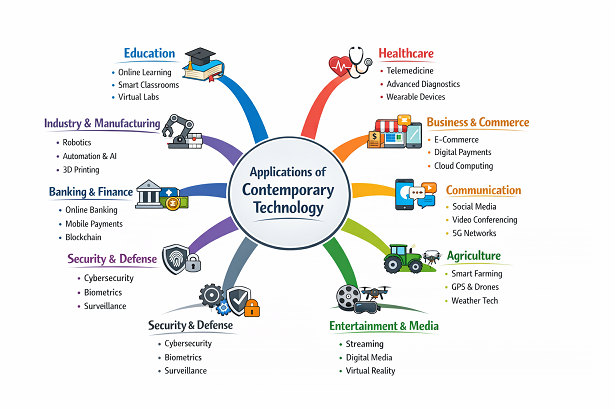
1. Education
Contemporary technology has transformed education by enabling online learning platforms, smart classrooms, and virtual labs. Students can access digital resources anytime and anywhere, making learning more interactive, flexible, and effective.
2. Healthcare
In healthcare, technology plays a critical role through telemedicine, advanced diagnostic machines like MRI and CT scans, digital health records, and wearable devices. These innovations improve patient care, allow remote consultations, and save lives.
3. Business and Commerce
Modern technology enhances business efficiency through e-commerce platforms, digital payment systems, cloud computing, and data analytics. Companies can reach global customers, make informed decisions, and operate more efficiently.
4. Communication
Technology has revolutionized communication with social media platforms, video conferencing tools, and high-speed mobile networks like 5G. People and businesses can connect instantly across the globe, breaking distance barriers.
5. Industry and Manufacturing
Industries benefit from robotics, automation, artificial intelligence, and 3D printing. These technologies increase productivity, reduce human error, and enable precise manufacturing of complex products.
6. Banking and Finance
Contemporary technology makes banking faster and safer with online banking, mobile wallets, UPI systems, and blockchain. Transactions are more secure, convenient, and transparent.
7. Security and Defense
Technology strengthens security through cybersecurity systems, biometric identification, and surveillance systems. It protects data, monitors critical areas, and enhances national defense capabilities.
8. Agriculture
Smart farming, GPS-based equipment, drones, and weather forecasting help farmers monitor crops, manage resources efficiently, and increase agricultural productivity.
9. Entertainment and Media
Streaming platforms, digital media production tools, and virtual reality create immersive entertainment experiences. Technology enables easy access to media content and supports creativity in the arts.
Advantages of Contemporary Technology
Improves Communication
Modern technology enables instant global communication through emails, social media, video calls, and mobile networks.Increases Productivity and Efficiency
Automation, AI, and robotics reduce manual labor, speed up production, and improve accuracy in industries and businesses.Enhances Education
E-learning platforms, smart classrooms, and digital resources make learning more interactive, flexible, and accessible.Advances Healthcare
Telemedicine, advanced diagnostic tools, and digital health records improve patient care and save lives.Supports Economic Growth
Technology creates new business opportunities, improves trade, and enhances online commerce.Promotes Innovation and Research
Modern tools and software facilitate experimentation, innovation, and scientific research.Improves Security
Cybersecurity systems, surveillance, and biometric identification protect data and lives.Enhances Entertainment and Media
Streaming platforms, VR, AR, and digital media provide immersive experiences and creative opportunities.
Disadvantages of Contemporary Technology
Dependency on Technology
Excessive reliance on technology can reduce problem-solving skills and self-reliance.Health Issues
Prolonged use of computers, smartphones, and gadgets may cause eye strain, back pain, and mental stress.Job Loss due to Automation
Machines and AI may replace manual labor, causing unemployment in certain sectors.Privacy and Security Risks
Cybercrime, hacking, and data breaches threaten personal and organizational information.Environmental Impact
Manufacturing electronic devices and e-waste can harm the environment if not properly managed.Social Isolation
Overuse of digital devices and social media can reduce face-to-face communication and social skills.High Cost
Advanced technologies and devices can be expensive to buy, maintain, and upgrade.
Compiled by Er. Basant Kumar yadav