
1. Introduction to Cybersecurity
In today’s digital world, computers, smartphones, cloud platforms, and internet-connected devices play an important role in everyday life. Individuals, businesses, educational institutions, banks, and government organizations use digital technologies to store information, communicate, manage operations, and deliver services.
However, increasing dependence on digital technology also creates security risks. Cybercriminals may attempt to steal personal information, access confidential business data, damage computer systems, or disrupt online services. Cybersecurity is essential for protecting computers, networks, applications, servers, and digital information against unauthorized access, cyberattacks, data theft, and other digital threats. Cybersecurity uses technologies, security policies, tools, and practices to protect digital systems and ensure the confidentiality, integrity, and availability of information.
For example, using strong passwords, enabling two-factor authentication, installing antivirus software, configuring firewalls, and regularly updating operating systems are common cybersecurity practices.
2. What Is Cybersecurity?
Cybersecurity refers to the practice of protecting computer systems, networks, applications, servers, and digital information from cyber threats, unauthorized access, damage, and theft.It involves a combination of hardware, software, security policies, and human awareness to protect digital assets.
Cybersecurity is also known as information technology security or electronic information security.Example: When a bank protects its customers’ online banking accounts using encryption, authentication, firewalls, and fraud detection systems, it is implementing cybersecurity.
3. Importance of Cybersecurity
Cybersecurity is important because individuals and organizations increasingly depend on digital systems to store and process sensitive information.
The major importance of cybersecurity is explained below.
3.1 Protection of Personal Information
Cybersecurity protects personal information such as names, addresses, passwords, phone numbers, financial details, and identification records from unauthorized access.
3.2 Prevention of Financial Loss
Cyberattacks can cause financial losses through online fraud, ransomware, identity theft, and unauthorized transactions. Security systems help reduce these risks.
3.3 Protection of Business Data
Organizations store confidential information such as customer records, employee information, financial reports, and business strategies. Cybersecurity protects these valuable assets.
3.4 Prevention of Unauthorized Access
Authentication systems, access controls, and encryption prevent unauthorized users from accessing confidential systems and information.
3.5 Maintaining Business Continuity
Cyberattacks can interrupt business operations and make services unavailable. Security measures, backups, and disaster recovery plans help organizations continue operating.
3.6 Building Customer Trust
Customers expect businesses to protect their personal and financial information. Strong cybersecurity practices improve confidence and trust.
4. Types of Cybersecurity
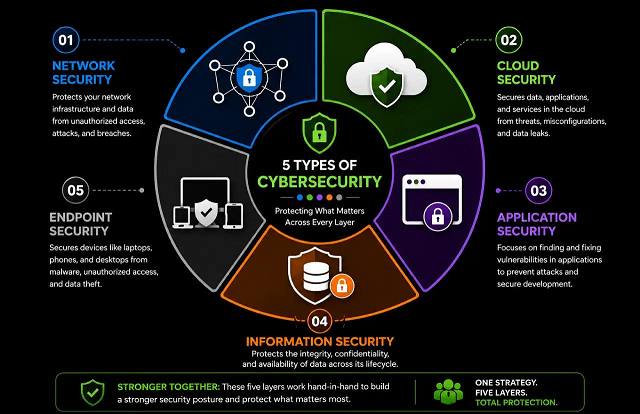
Cybersecurity consists of several specialized areas that protect different parts of digital infrastructure.
4.1 Network Security
Network security protects computer networks against unauthorized access, misuse, attacks, and data theft.It involves firewalls, intrusion detection systems, intrusion prevention systems, network monitoring, and access control.
Example: A company uses a firewall to prevent unauthorized internet traffic from entering its internal network.
4.2 Application Security
Application security protects software applications from vulnerabilities and cyberattacks.It includes secure coding, authentication, authorization, security testing, and regular software updates.
Example: A banking application uses secure login systems and encryption to protect customer information.
4.3 Information Security
Information security protects digital and physical information against unauthorized access, modification, disclosure, and destruction.
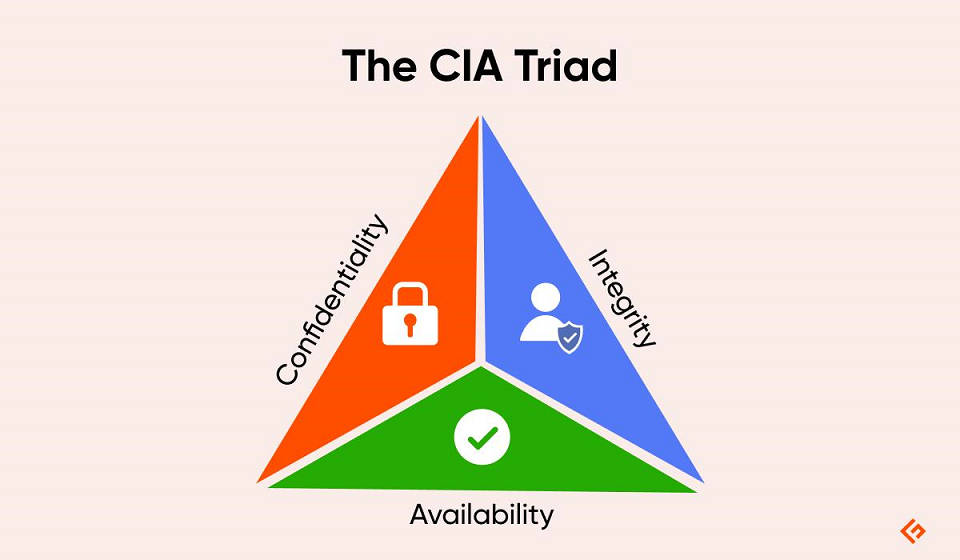
It focuses on maintaining three important principles:
- Confidentiality: Information is accessible only to authorized users.
- Integrity: Information remains accurate and is not modified without authorization.
- Availability: Information and services remain accessible when required.
These three principles are collectively known as the CIA Triad.
4.4 Cloud Security
Cloud security protects data, applications, and infrastructure hosted on cloud computing platforms. It includes encryption, identity management, access control, cloud monitoring, and secure configuration.
Example: Organizations use security features provided by Amazon Web Services (AWS), Microsoft Azure, and Google Cloud to protect cloud resources.
4.5 Endpoint Security
Endpoint security protects devices connected to a computer network, including desktop computers, laptops, smartphones, and servers. It uses antivirus software, endpoint detection and response (EDR), device management, and security policies.
Example: Installing endpoint protection software on employee computers helps detect and prevent malware infections.
4.6 Mobile Security
Mobile security protects smartphones, tablets, mobile applications, and mobile data from security threats. It includes screen locks, biometric authentication, application permissions, encryption, and secure mobile operating systems.
4.7 Internet of Things (IoT) Security
IoT security protects internet-connected devices such as smart cameras, smart televisions, sensors, smart appliances, and industrial control devices.It prevents unauthorized access and protects connected devices from cyberattacks.
4.8 Operational Security
Operational security (OPSEC) involves policies and procedures for managing and protecting sensitive information and technology resources.It includes user permissions, access management, security procedures, and data handling policies.
5. Common Cybersecurity Threats
Cybersecurity threats are malicious activities that attempt to damage, steal, expose, or gain unauthorized access to digital systems and information.
The most common cybersecurity threats include:

5.1 Malware
Malware stands for malicious software. It is designed to damage computer systems, steal information, disrupt operations, or gain unauthorized access.
Common types of malware include:
- Virus
- Worm
- Trojan horse
- Spyware
- Ransomware
- Adware
Rootkit
5.2 Phishing
Phishing is a cyberattack in which attackers use fake emails, websites, messages, or links to trick users into revealing sensitive information. For example, a user may receive a fake banking email asking them to verify their account password through a fraudulent website.
5.3 Ransomware
Ransomware is a type of malware that encrypts files or locks computer systems and demands payment to restore access. It can affect individuals, hospitals, educational institutions, businesses, and government organizations.
5.4 Password Attacks
Password attacks attempt to obtain or guess users’ passwords to gain unauthorized access to accounts and computer systems.Examples include brute-force attacks, credential stuffing, and password spraying.
5.5 Denial-of-Service (DoS) Attacks
A Denial-of-Service attack attempts to make a computer system, website, or network service unavailable by overwhelming it with excessive requests or traffic.A Distributed Denial-of-Service (DDoS) attack uses multiple compromised devices to generate malicious traffic.
5.6 Man-in-the-Middle (MITM) Attacks
A Man-in-the-Middle attack occurs when an attacker secretly intercepts or potentially modifies communication between two parties.For example, attackers may exploit an insecure public Wi-Fi network to intercept sensitive information.
5.7 SQL Injection
SQL injection is a web application vulnerability in which malicious SQL input is used to manipulate database queries.It may allow attackers to access, modify, or delete database information.
5.8 Social Engineering
Social engineering involves manipulating people into revealing confidential information or performing actions that compromise security.It often uses deception, impersonation, urgency, or trust.
6. Cybersecurity Tools and Technologies
Different cybersecurity tools are used to detect, prevent, and respond to cyber threats.
Tool/Technology | Main purpose |
|---|---|
Firewall | Controls incoming and outgoing network traffic |
Antivirus | Detects and removes malicious software |
VPN | Creates an encrypted network connection |
IDS | Detects suspicious network activities |
IPS | Detects and blocks malicious traffic |
Encryption | Protects information by converting it into an unreadable format |
Password Manager | Stores and manages passwords securely |
EDR | Monitors and responds to endpoint threats |
SIEM | Collects and analyzes security events |
MFA | Adds additional identity verification |
Popular Cybersecurity Software and Platforms
Organizations and individuals use different security solutions depending on their requirements.
- Microsoft Defender – Security and threat protection solutions.
- Bitdefender – Antivirus and endpoint security.
- Norton – Consumer cybersecurity and online protection.
- CrowdStrike Falcon – Endpoint detection and response.
- Cloudflare – Website security, DDoS protection, and network services.
- Cisco Security – Enterprise network security solutions.
7. Best Cybersecurity Practices to Protect Your Digital Life
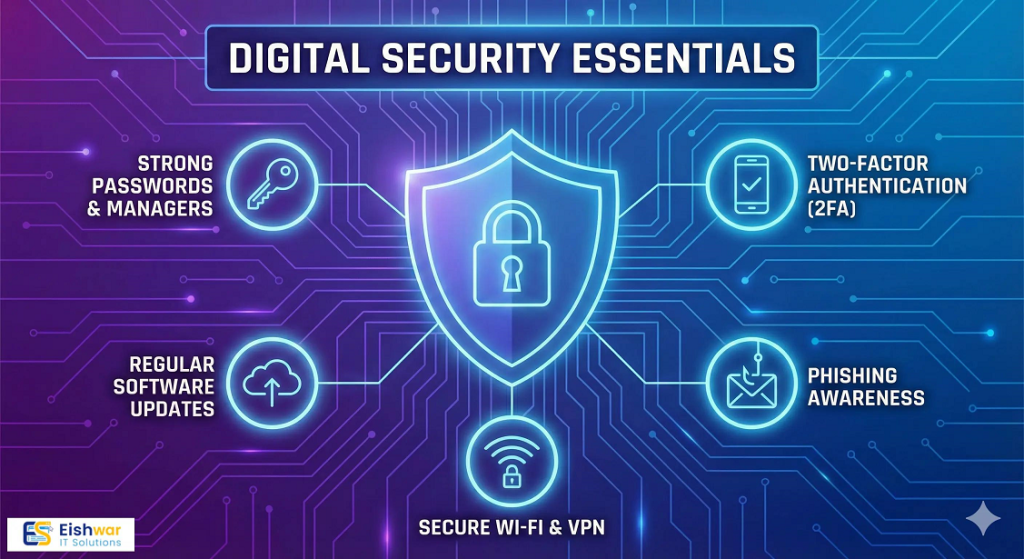
Following good cybersecurity practices helps individuals and organizations reduce the risk of cyberattacks.
7.1 Use Strong and Unique Passwords
Create long, unique passwords for different online accounts. Avoid using easily guessed information such as birthdays, names, or simple number combinations.
A password manager can help generate and securely store passwords.
7.2 Enable Two-Factor Authentication
Two-factor authentication (2FA) adds another layer of security to online accounts.
Even if someone obtains your password, they may still need a second verification method to access your account.
7.3 Keep Software Updated
Regularly update operating systems, browsers, applications, and security software to fix known security vulnerabilities.
7.4 Install Reliable Antivirus Software
Use reputable antivirus or endpoint protection software to detect and prevent malware infections.
7.5 Avoid Suspicious Emails and Links
Do not open unknown attachments or click suspicious links. Verify the sender before providing sensitive information.
7.6 Use Secure Wi-Fi Networks
Protect wireless networks with strong passwords and modern encryption. Avoid accessing sensitive accounts through untrusted public Wi-Fi networks.
7.7 Back Up Important Data
Maintain regular backups of important files using secure cloud storage or external storage devices.
Backups help recover information after accidental deletion, hardware failure, or ransomware incidents.
7.8 Use Encryption
Encryption protects sensitive information by converting readable data into an encoded format that requires the appropriate key to decrypt.
7.9 Limit User Access
Provide users with only the permissions necessary to perform their responsibilities. This principle is known as the principle of least privilege.
7.10 Educate Users About Cyber Threats
Train employees, students, and family members to recognize phishing emails, suspicious websites, social engineering, and other security risks.
8. Applications of Cybersecurity
Cybersecurity is used in almost every industry that depends on digital technology.
Industry | Application of cybersecurity |
|---|---|
Banking | Protecting online banking and financial transactions |
Healthcare | Protecting electronic medical records |
Education | Securing student information and learning platforms |
Government | Protecting national and public information systems |
E-commerce | Securing online shopping and payment transactions |
Telecommunications | Protecting communication infrastructure |
Manufacturing | Securing industrial control systems |
Cloud Computing | Protecting cloud applications and stored data |
9. Cybersecurity vs Information Security
Cybersecurity and information security are closely related, but they are not exactly the same.
Cybersecurity | Information Security |
|---|---|
Focuses on protecting digital systems and assets. | Focuses on protecting information in all forms. |
Addresses cyberattacks and online threats. | Addresses unauthorized access, disclosure, modification, and destruction. |
Includes network, application, and endpoint security. | Includes physical, administrative, and technical controls. |
Primarily deals with digital environments. | Covers digital and physical information. |
In simple terms: Cybersecurity is a specialized part of the broader field of information security.
10. Future of Cybersecurity
Cybersecurity continues to evolve as new technologies and cyber threats emerge.
Some important developments shaping the future of cybersecurity include:
- Artificial Intelligence in Cybersecurity: AI helps identify unusual activities, detect threats, and automate security monitoring.
- Zero Trust Security: This approach requires continuous verification instead of automatically trusting users or devices.
- Cloud Security: Increasing cloud adoption creates greater demand for cloud security solutions.
- IoT Security: More connected devices require stronger security and monitoring.
- Quantum-Safe Cryptography: Organizations are preparing cryptographic systems to resist potential future quantum computing threats.
- Security Automation: Automated tools help security teams detect and respond to threats more efficiently.
11. Conclusion
Cybersecurity is an essential part of modern digital life. It protects computer systems, networks, applications, and sensitive information against unauthorized access, cyberattacks, and data theft.
Understanding cybersecurity types, common threats, security tools, and preventive practices helps individuals and organizations maintain a safer digital environment.
As technology continues to develop, cybersecurity will become increasingly important for businesses, educational institutions, financial organizations, governments, and individual internet users.
Everyone should follow basic security practices, including using strong passwords, enabling two-factor authentication, updating software, avoiding suspicious links, and maintaining regular data backups.
Frequently Asked Questions (FAQs)
1. What is cybersecurity in simple words?
Cybersecurity is the practice of protecting computers, networks, applications, and digital information from hackers, malware, unauthorized access, and other cyber threats.
2. What are the five main types of cybersecurity?
Five major areas are network security, application security, information security, cloud security, and endpoint security.
3. What are the most common cybersecurity threats?
Common threats include malware, phishing, ransomware, password attacks, DDoS attacks, SQL injection, and social engineering.
4. Why is cybersecurity important?
Cybersecurity protects personal information, prevents financial losses, secures business data, reduces unauthorized access, and helps maintain business continuity.
5. What is the difference between cybersecurity and network security?
Cybersecurity protects digital systems and information from cyber threats, while network security specifically protects computer networks and their communication infrastructure.
6. Which software is used for cybersecurity?
Popular cybersecurity solutions include Microsoft Defender, Bitdefender, Norton, CrowdStrike Falcon, and Cisco security products.
7. What are the three principles of cybersecurity?
The three fundamental principles are Confidentiality, Integrity, and Availability, collectively known as the CIA Triad.
8. Is cybersecurity a good career?
Yes. Cybersecurity offers career opportunities in security analysis, penetration testing, security engineering, incident response, cloud security, and security consulting. Professional qualifications and practical experience can help build a career in this field.
About the Author
Er. Basant Kumar Yadav is an Electronics and Communication Engineering graduate, educator, technology enthusiast, and blogger. He writes educational articles and practical tutorials on computer engineering, programming, networking, web development, and emerging technologies.
Website: BasantYadav.com.np