
Kinematics
Kinematics is the study of motion in terms of displacement, velocity, acceleration, and time, without discussing the causes (forces).
Acceleration (a):
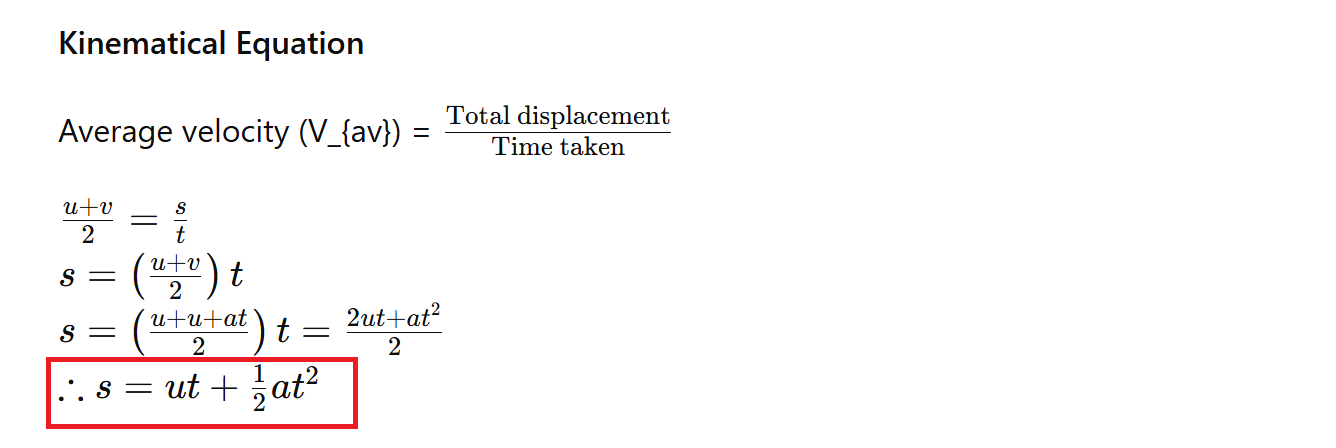
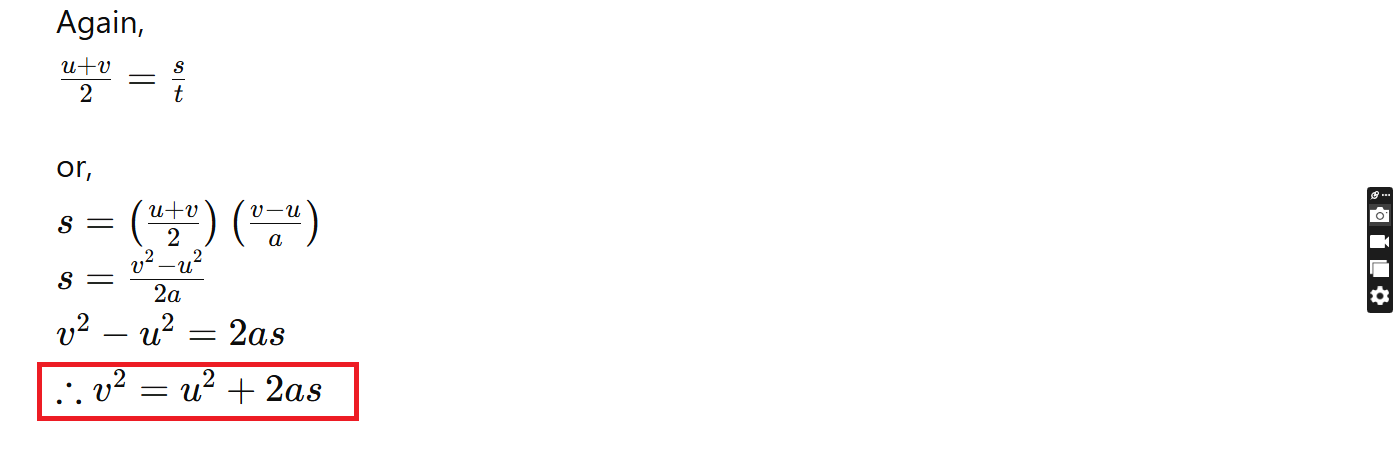
Acceleration is the rate of change of velocity with respect to time. We have:
a = (v-u) / t
v – u = at
v = u + at — ①
Again,
t = (v – u) / a — ②
Where,
u ⇒ Initial velocity
v ⇒ Final velocity
t ⇒ time taken
s ⇒ total displacement covered
a ⇒ acceleration
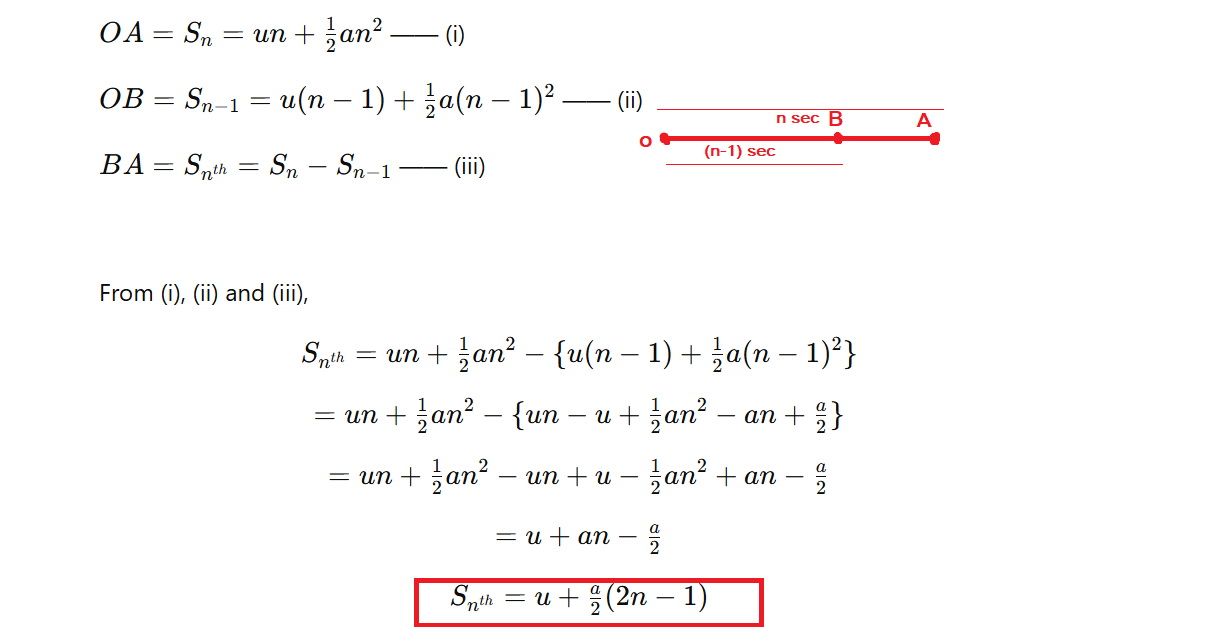
Distance travelled by a body in nᵗʰ second (Sₙₜₕ)
From the figure,

Example Problem
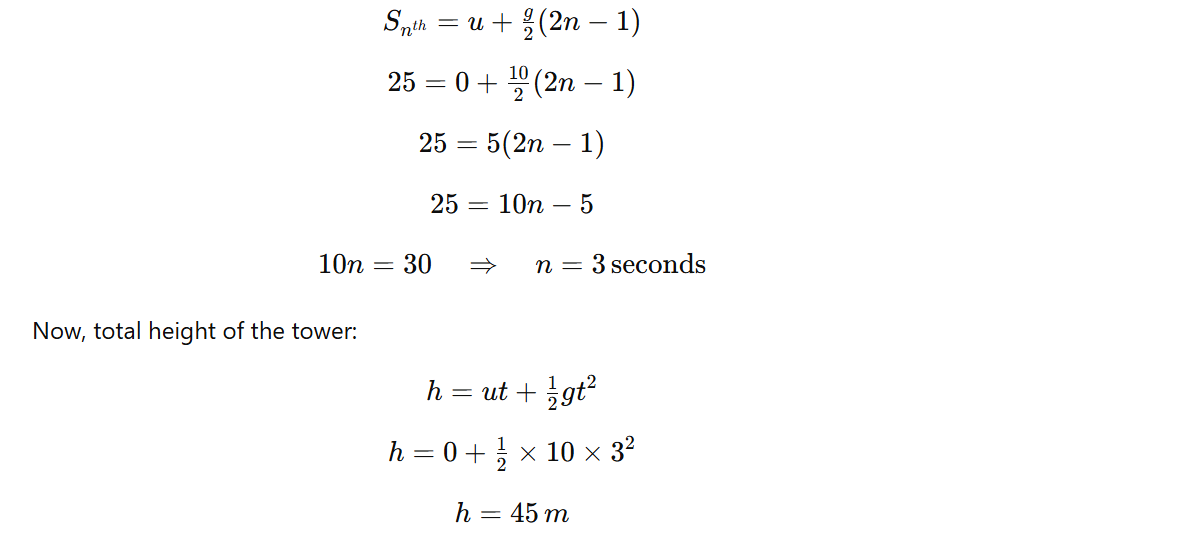
Q: A man drops a ball from the top of a tower. The ball covers 25 m in the last second before hitting the ground. Find the height of the tower.
Solution:
Initial velocity u=0 m/s
Acceleration due to gravity g=10 m/s2
Distance in nth second is given by:
Projectile
A body which, once thrown into space, moves under the influence of gravity only is called a projectile, and such a motion is described as projectile motion. The path followed by a projectile is known as its trajectory.
Projectile Fired Horizontally From a Height
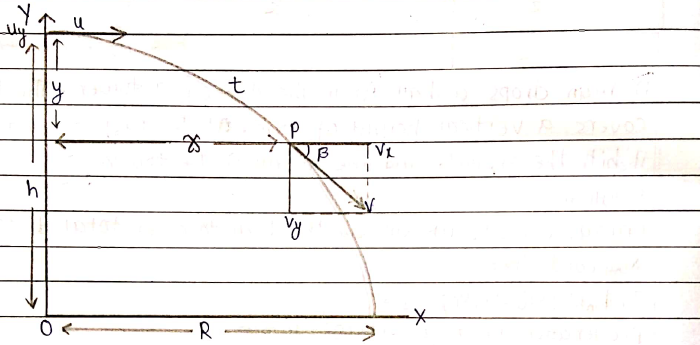
Fig: Projectile fired horizontally
Let us consider a projectile that is fired from the top of a tower of height h, with a horizontal velocity u. Due to the influence of gravity, it will fall on the ground after some time t, covering some distance on the ground, following a certain path as shown in the figure.
Let the body travel a horizontal distance x and vertical distance y from the initial point in time t, making its velocity v at this moment at the point P.
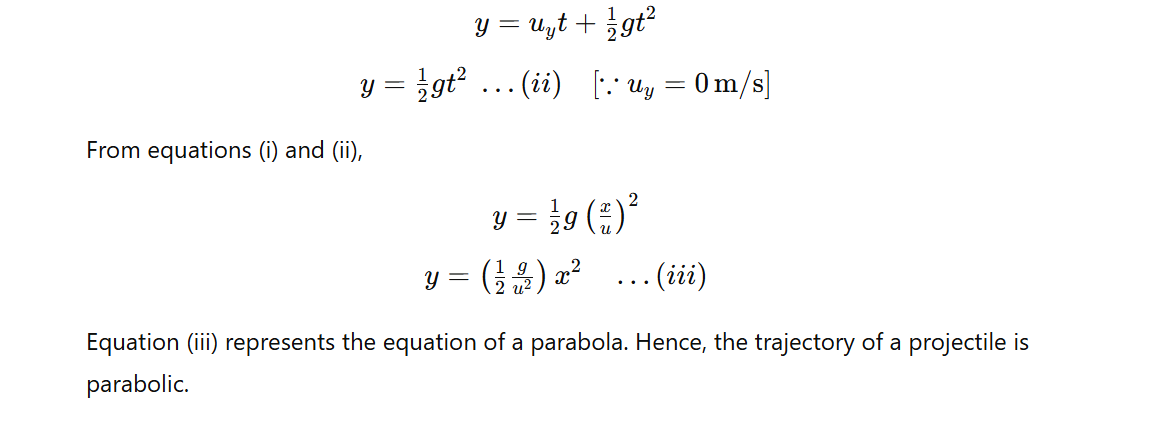
Equation of Trajectory
We know:
x=ut
t=x/u…(i)
Also,
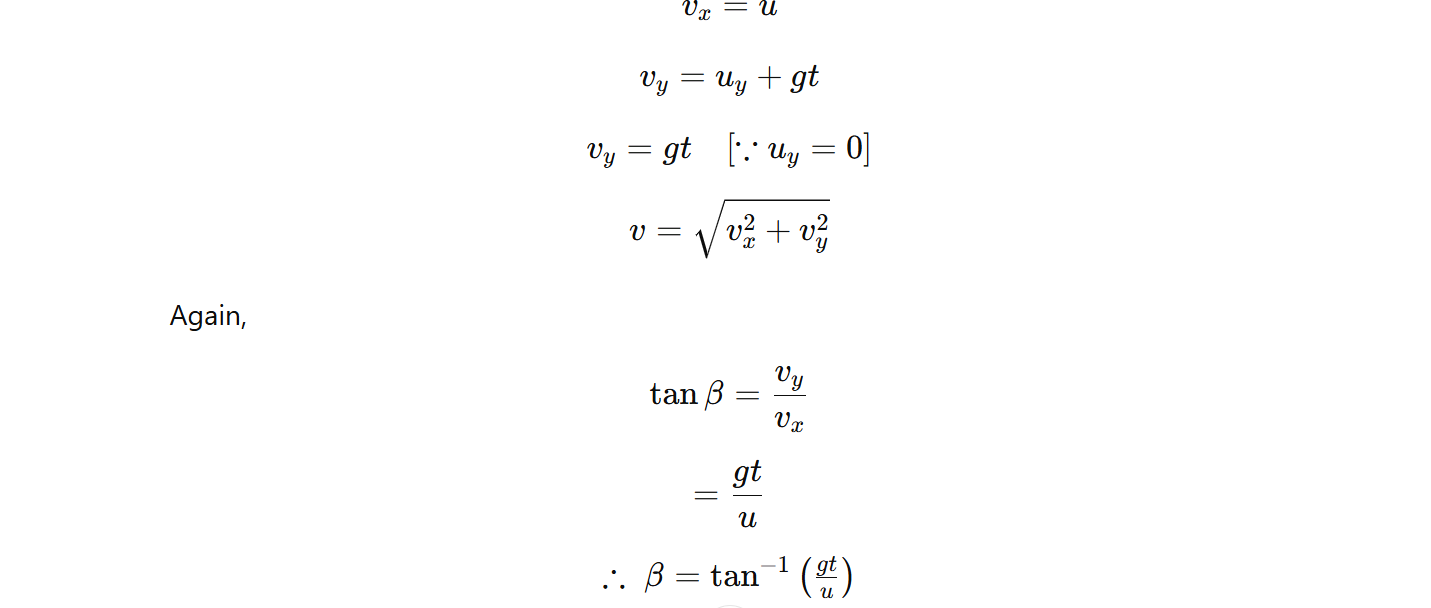
 Velocity at any Instant (v):
Let be the resultant velocity at point and β be the angle made by v with vx . vx and vy are velocity components along the horizontal and vertical directions, respectively.
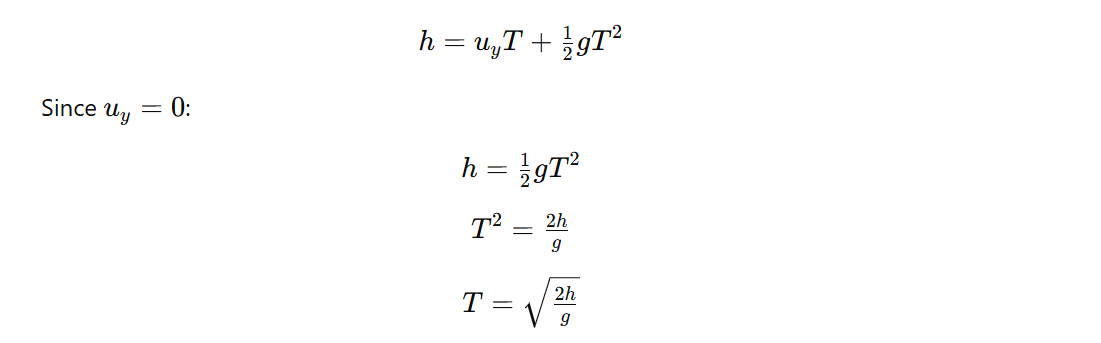
Time of Flight (T)
Time of flight is the total time for which the projectile remains in the air. It is denoted by T
We have,
Horizontal Range (R)
It is the horizontal distance covered by the projectile during the time of flight.

Projectile Fired at an Angle with the Horizon
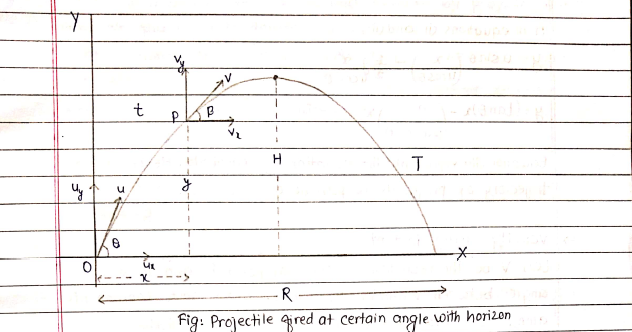
Let us consider a body is thrown into space with initial velocity uu, making an angle θ\theta with the horizontal, as shown in the figure.The velocity components are:
ux=ucosθ, uy=usinθ
Here,ux and uy are the initial velocity components along horizontal and vertical directions, respectively. Since there is no acceleration along the horizontal direction, the horizontal velocity component remains constant throughout the motion. In projectile motion, the resistance of air is neglected.
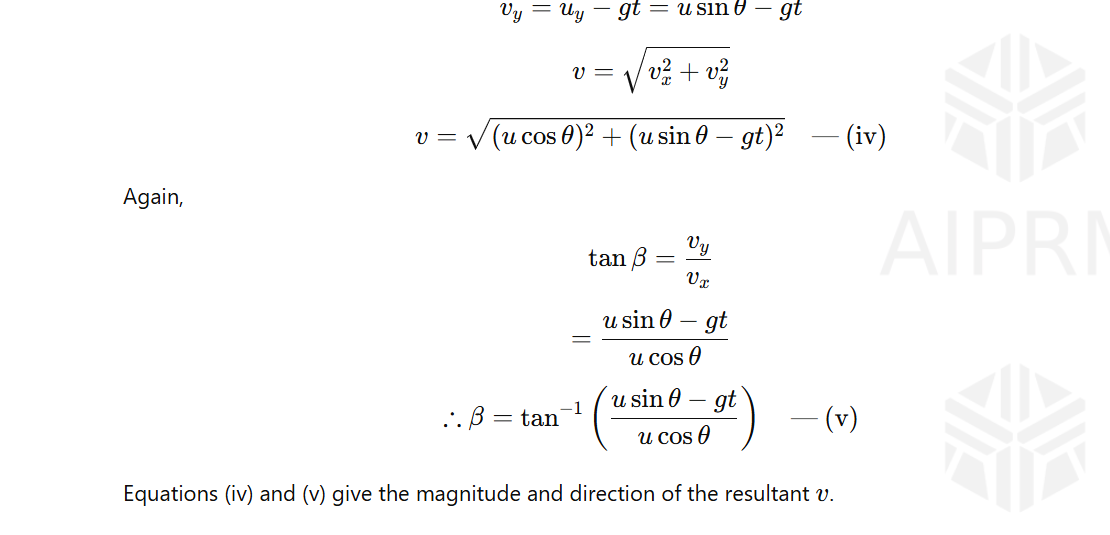
Equation of Trajectory
Let P be a point on the path of the projectile such that x and y are the horizontal and vertical displacements at time t. From horizontal motion: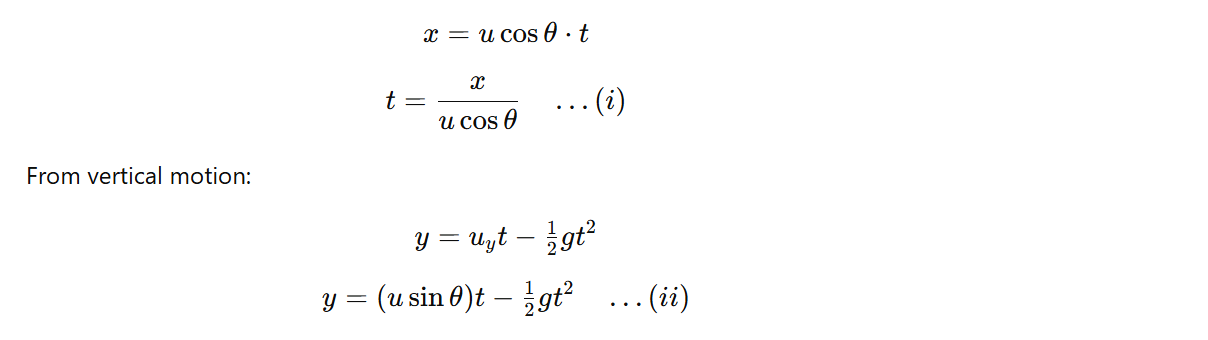
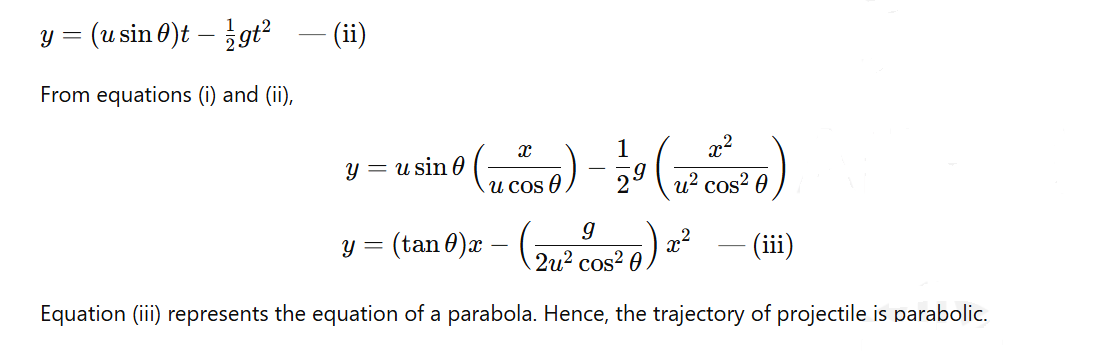 velocity at any instant:
Let be the resultant velocity at point P and β be the angle between v and vx .vx and vy are velocity components along horizontal and vertical directions, respectively.
ux= ux=ucosθ
Maximum height (H)
It is the maximum vertical distance covered by projectile during time of flight. It is denoted by H.At maximum height vertical velocity component is zero (0).
Vy’ = 0
Now,
Vy² = Uy² – 2gH
0 = u²sin²θ – 2gH
H = (u²sin²θ) / 2g — (vi)
Time of a scend (t’)
It is the time taken by the projectile to reach maximum height.
Vy’ = Uy – gt’
0 = usinθ – gt’
t’ = (usinθ) / g — (vii)
Time of Flight (T)
It is the total time for which the projectile remains in air. It is denoted by T. During time of flight, net vertical height gained by the projectile is 0.
0 = VyT – ½ gT²
0 = usinθ – ½ gT [:: Dividing both sides by T]
∴ T = (2usinθ) / g — (viii)
Time of descent (t’’)
t’’ = T – t’
= (2usinθ / g) – (usinθ / g)
= (usinθ / g) — (ix)
Horizontal Range (R)
It is the maximum horizontal distance covered by the projectile during the time of flight.
R = UxT
R = ucosθ × (2usinθ / g)
R = (u²sin2θ) / g — (x)
The horizontal range will be maximum if sin2θ = 1
i.e. sin2θ = sin90°
∴ 2θ = 90°
∴ θ = 45°
At what angle of projection maximum height and horizontal range are equal?
Solution:
Maximum height (H) = Horizontal Range (R)
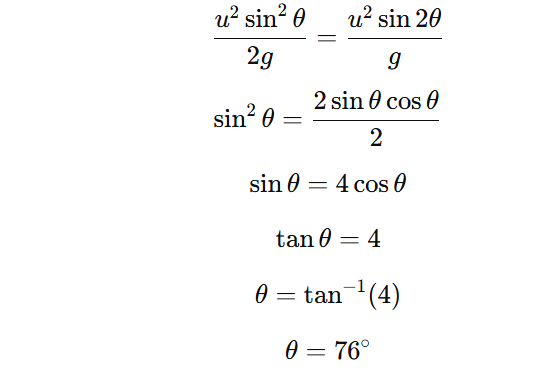
∴ Maximum height and horizontal range are equal at 76° angle of projection.
NUMERICAL PROBLEMS
A swimmer’s speed along the river is 20 km/hr and upstream is 8 km/hr. Calculate the velocity of the stream and the swimmer’s possible speed in still water. [2075 (TIE Q. No. 9a)]
Solution :
Let, the velocity of the swimmer in still water and that of the stream be Vx and Vy respectively.
Speed upstream = Vx – Vy
∴ Vx – Vy = 8 km/hr — (i)
Speed downstream = Vx + Vy
∴ Vx + Vy = 20 km/hr — (ii)
From equations (i) and (ii)
2Vx = 28
∴ Vx = 14 km/hr
Substituting the value of Vx in equation (ii)
Vy = 20 – 14
∴ Vy = 6 km/hr.
∴ The velocity of the stream is 6 km/hr and swimmer’s possible speed in still water is 14 km/hr.
A body is projected upwards making an angle θ with the horizontal with a velocity of 300m/s. Find the value of θ so that the horizontal range will be maximum. Hence find its range and time of flight. [2075 set B Q. No. 9a]
Solution:
Angle of a body projected upward with the horizontal = θ
Initial velocity (u) = 300m/s
We know,
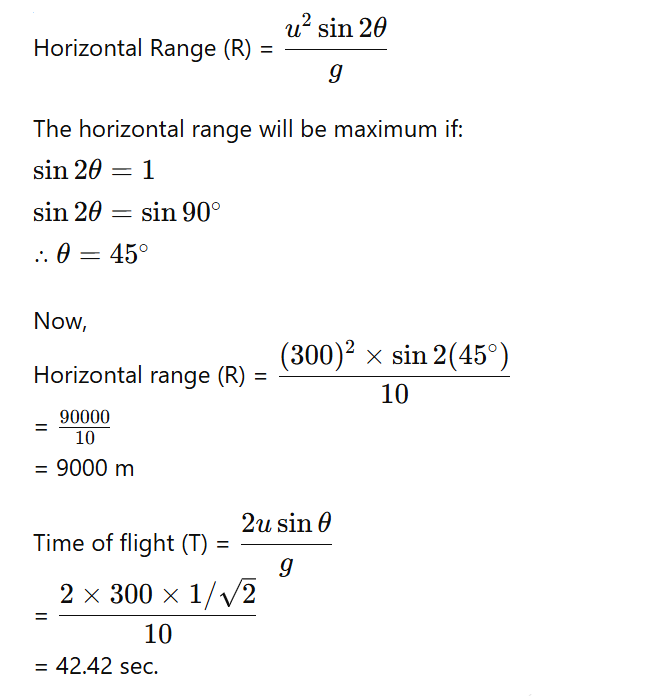
∴ The horizontal range will be maximum if θ=45∘\theta = 45^\circ. Hence, its range is 9000m and time of flight is 42.42 sec.
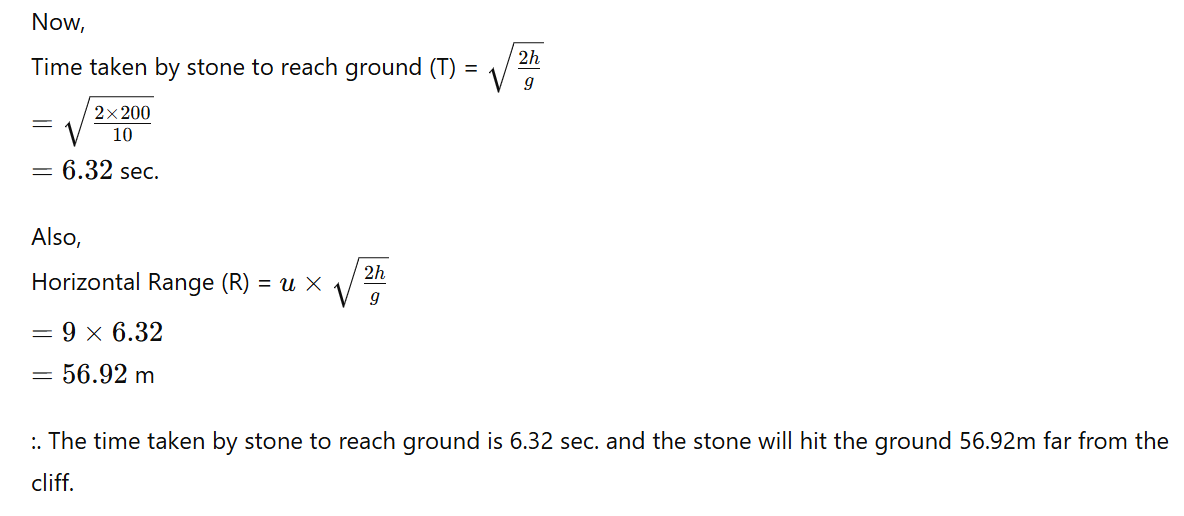
A stone on the edge of a vertical cliff is kicked so that its initial velocity is 9m/s horizontally. If the cliff is 200m high, calculate (2074 Supp. Q. No. 9a)
i. Time taken by stone to reach the ground.
ii. How far from the cliff the stone will hit the ground?
Solution:
Height of the cliff (h) = 200m
Initial velocity of the stone horizontally (u) = 9m/s
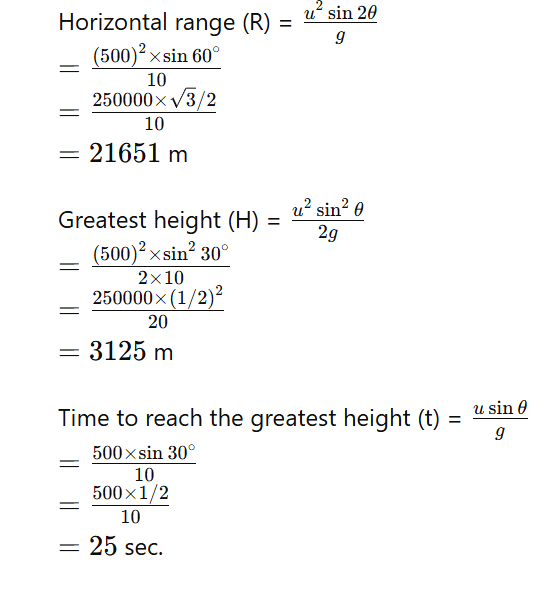
A projectile is fired from the ground level with a velocity of 500 m/s at 30° to the horizon. Find the horizontal range, the greatest height, and the time to reach the greatest height. [2074 set3/2079 Supp/ 2066 Q.No.9a]
Solution:
Initial velocity of a projectile (u) = 500 m/s
Angle of the projectile with the horizon (θ) = 30°.
Now,
A batter hits a baseball so that it leaves the bat with an initial speed of 37 m/s at an angle of 53°. Find the position of the ball and the magnitude and direction of its velocity after 2 seconds. [2013 Set C Q.No. 9a]
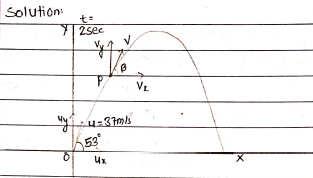
Let P be a point on the path of the baseball such that it reaches the point P in 2 seconds. v be the resultant velocity at point P. vₓ and vᵧ are velocity components along horizontal and vertical directions respectively. β be the angle made by v with vₓ.
Given,
t = 2 sec
u=37 m/s
θ=53∘
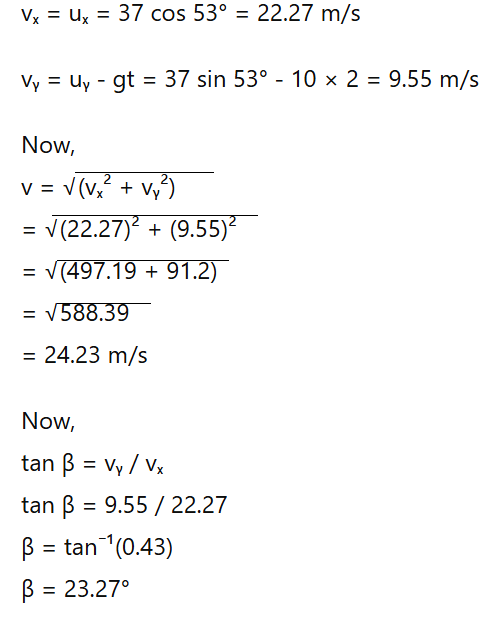
Thus, the magnitude and direction of the velocity of the baseball are 24.23 m/s and 23.27° respectively.
A baseball is thrown towards a player with an initial velocity 20 m/s and 45° with the horizontal. At the moment, the ball is thrown, the player is 50m from the thrower. At what speed and in which direction must he run to catch the ball at the same height at which it is released?
Solution: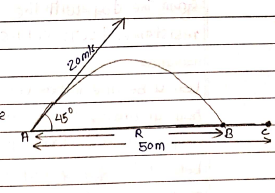
Initial velocity (u) = 20 m/s
Angle of projection (θ) = 45°
Distance between the thrower and the player (x) = 50m
We know,
Horizontal Range = u² sin 2θ/g
= (20)² × sin 2(45°)/10
= 40m
And,
Time of Flight = 2u sinθ / g
= 2 × 20 × sin 45° / 10
= 2.83 sec
Now,
The distance required to run = 50m – 40m = 10m
The speed with which the player must run
= Distance covered / time taken
= 10 / 2.83 = 3.53 m/s
A bullet is fired with a velocity of 100 m/s from the ground at an angle of 60° with the horizontal. Calculate the horizontal range covered by the bullet. Also, calculate the maximum height attained. [2017 Set C. No. 9d]
Solution: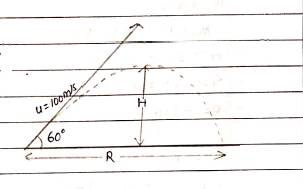
Let u be the initial velocity of a bullet,
H be the maximum height attained and
R be the horizontal range covered.
Then,
u = 100 m/s
H = ?
R = ?
We know,
R = u² sin 2θ / g
= (100)² × sin 2(60°) / 10
= 10000 × √3/2 / 10
= 866 m
H = u² sin²θ / 2g
= (100)² × sin²60° / 2 × 10
= 10000 × 3/4 / 20
= 375 m