
What is Relational Model?
The relational model is a simple and powerful data model proposed by E. F. Codd in 1970. It represents data in the form of tables (relations) and uses a mathematical concept of relations from set theory. In this model, data is organized into rows and columns, where each row represents a tuple and each column represents an attribute.
Features of Relational Model
- Data is stored in tables (relations).
- Each table has a unique name.
- Each row represents a tuple (record).
- Each column represents an attribute (field).
- Values in a column are from the same domain (data type).
- Uses primary key to uniquely identify a tuple.
- Supports relational algebra and SQL for data manipulation.
- Provides data independence and reduces data redundancy.
Structure of a Relation
In the Relational Model of a Database, a relation is represented as a two-dimensional table consisting of rows and columns. Each relation stores information about a particular entity, such as Student, Employee, Course, Department, Product, etc.The main components of the structure of a relation are tuples, attributes, domains, degree, and cardinality.
- Tuples (Rows): Each row represents a single record or entity.
- Attributes (Columns): Each column represents a property of the entity.
- Domain: Set of allowed values for each attribute.
- Degree: Number of attributes in a relation.
- Cardinality: Number of tuples (rows) in a relation.
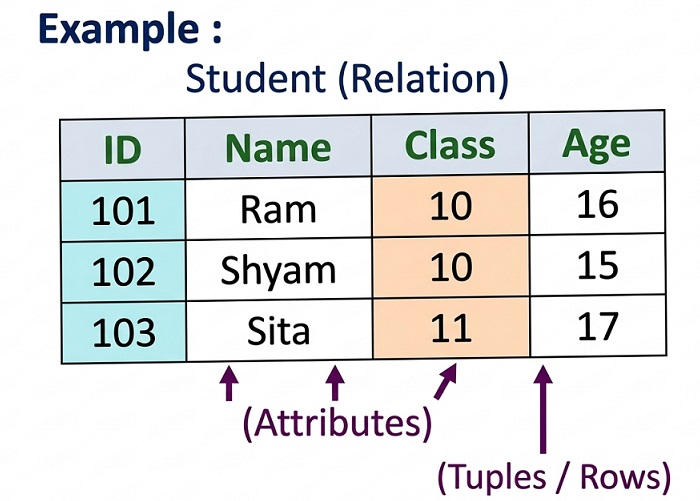
For example, consider the following Student relation:
In the above Student relation,
Degree = 4 (ID, Name, Class, Age)
Cardinality = 3 (3 tuples / rows)
Relational Constraints
Relational constraints are rules applied to the data in a relational database to maintain accuracy, consistency, validity, and integrity of the data.They prevent incorrect, duplicate, or meaningless data from being entered into the database.
1. Domain Constraint :A domain constraint specifies that an attribute can contain only values from its defined domain.For example, consider a Student table:
2.Entity Constraints
Entity constraints are rules that ensure that every row (tuple) in a relation can be uniquely identified and that important key values are not missing.The main entity constraint is the Entity Integrity Constraint.Entity constraint means that every record in a table must have a unique identification number.